
25 Emotional Regulation Activities for Young Children
Discover 25 simple, low-cost emotional regulation activities for young children to use at home or school, plus tips for teachers and parents.
A four-year-old grabs a toy back from her friend and shoves him. A six-year-old melts into tears because his tower fell down for the third time. A five-year-old refuses to get in the car and screams “I hate you!” at the top of her lungs.
If you spend any time with young children, scenes like these are part of your everyday life. Saying “calm down” rarely works in the moment, because calming down is a skill, not a switch children can flip on command.
That skill is called emotional regulation, and it can be taught. This article walks through what emotional regulation actually means, why it matters so much in the early years, and shares 25 emotional regulation activities for young children that you can use right away at home or in the classroom. Every activity is simple, low-cost, and realistic for busy adults.
What Is Emotional Regulation?
Emotional regulation is the ability to notice, understand, and manage feelings in a way that fits the situation. It is a skill that develops slowly over many years, starting in toddlerhood and continuing well into the school years and beyond.
It’s easy to misunderstand what this actually means, so let’s clear up a few myths first.
Emotional regulation does not mean:
- Never getting angry
- Never crying
- Always staying calm and quiet
- Ignoring or suppressing difficult feelings
Instead, emotional regulation means gradually learning to:
- Notice what they are feeling in their body
- Name the feeling (“I’m frustrated,” “I’m scared”)
- Understand what caused the feeling
- Express the feeling in a safe, appropriate way
- Use a strategy to help their body and mind feel calmer
- Ask an adult for help when the feeling is too big to manage alone
Young children are not born knowing how to do any of this. Their brains are still building the connections needed for self-control, so they rely on caring adults to guide them, model calm behaviour, and give them tools to practise. This is completely normal, and it’s exactly why emotional regulation activities are so valuable.
Why Is Emotional Regulation Important for Young Children?
Emotional regulation touches almost every part of a young child’s day, even when it isn’t obvious.
- Learning: A child who is overwhelmed by frustration cannot focus on a puzzle, a story, or a math worksheet. Calm bodies learn better.
- Friendships: Children who can manage disappointment and anger are better able to share, take turns, and repair conflicts with friends.
- Communication: When children can name their feelings instead of just acting them out, they can tell adults and peers what they need.
- Problem-solving: A calmer child can think through what to do next, instead of getting stuck in a big reaction.
- Independence: Children who have practised coping strategies feel more confident handling small setbacks on their own.
- Classroom behaviour: Many behaviour challenges in preschool and kindergarten are really emotional regulation challenges in disguise.
- Confidence: Children who learn that big feelings can be managed, not just endured, grow up trusting themselves more.
These are lifelong skills, and the early years are one of the best times to start building them. Read more
25 Emotional Regulation Activities for Young Children
Below are 25 genuinely different emotional regulation activities for young children, designed for preschool, kindergarten, and early primary ages. Try a few at a time rather than all at once, and remember: these work best when practised during calm moments, not only during meltdowns.
Activity 1: Feelings Detective
What children learn: How to notice and name emotions in themselves and others.
What you need: None (optional: picture books or family photos).
How to do it:
- Look at a picture of a face, a character in a book, or each other.
- Ask, “What clue tells us how this person feels?”
- Point to the eyebrows, mouth, or posture.
- Name the feeling together.
Teacher/Parent Example: “Look at his eyebrows and his mouth. What do you think he’s feeling?”
Best for: Ages 3–7, home and classroom.
Why it helps: Builds the vocabulary and awareness children need before they can manage a feeling.
Activity 2: Emotion Cards Sort
What children learn: To recognise different emotions and connect them to situations.
What you need: A simple set of printed or drawn emotion cards (happy, sad, angry, scared, excited, frustrated).
How to do it:
- Spread the cards on a table.
- Describe a short situation (“Your ice cream fell on the ground”).
- Ask the child to pick the card that matches how they might feel.
- Talk briefly about why.
Teacher/Parent Example: “If your block tower fell down, which card matches how you might feel?”
Best for: Ages 3–6, home and classroom.
Why it helps: Connects real-life events to specific emotion words, building emotional vocabulary.
Activity 3: Feelings Thermometer
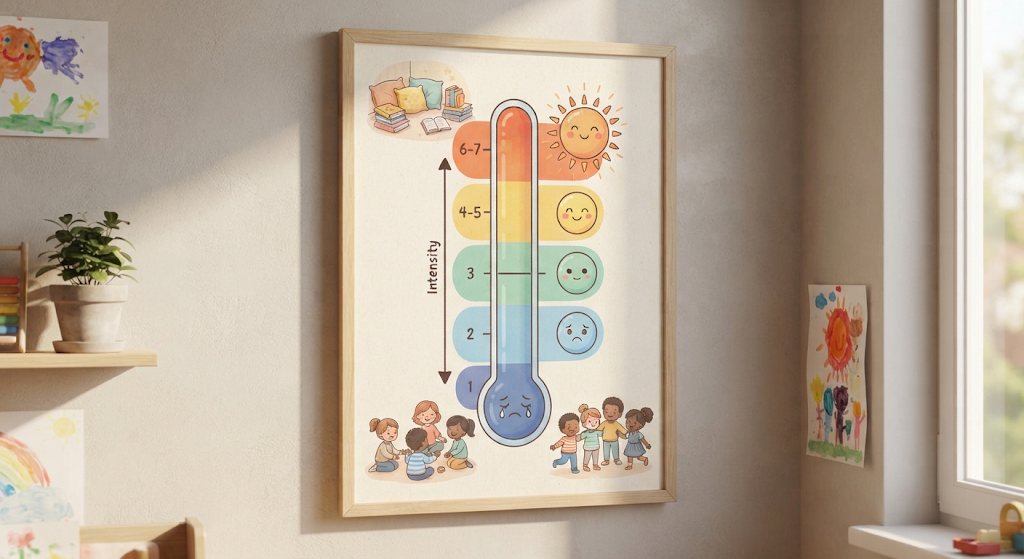
What children learn: To notice how big or small a feeling is, not just what the feeling is.
What you need: A drawn thermometer with sections from “calm” to “very upset,” or a printed version.
How to do it:
- Show the thermometer and explain each level in simple words.
- Ask the child to point to where their feeling is right now.
- Talk about what a strategy for that level might look like.
Teacher/Parent Example: “Where is your feeling on the thermometer today?”
Best for: Ages 4–8, home and classroom.
Why it helps: Helps children catch a feeling early, before it becomes overwhelming.
Activity 4: Build a Calm-Down Corner Together
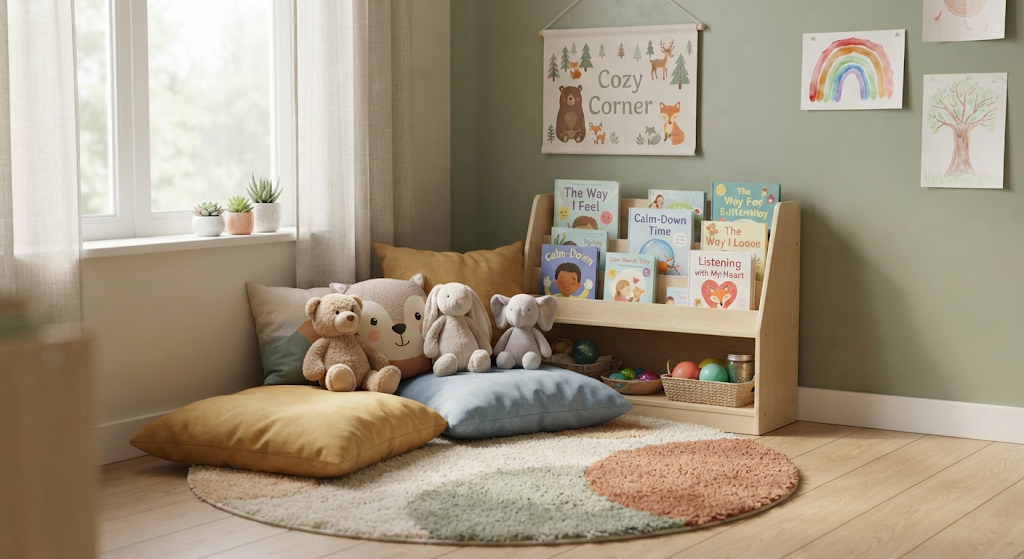
What children learn: That there is a safe, dedicated space to go to when feelings get big.
What you need: A quiet corner, cushions, soft toys, a few calming tools.
How to do it:
- Choose a low-traffic corner of the room.
- Let the child help pick items to put there.
- Practise visiting the corner when everyone is calm.
- Explain it’s a choice, not a punishment.
Teacher/Parent Example: “This is our calm corner. You can go there anytime your body needs a break.”
Best for: Ages 3–8, home and classroom.
Why it helps: Gives children a predictable place and routine for calming down.
Activity 5: Balloon Breathing

What children learn: A simple physical way to slow the body down.
What you need: None.
How to do it:
- Ask the child to put their hands on their belly.
- Breathe in slowly through the nose, imagining a balloon filling up.
- Breathe out slowly through the mouth, imagining the balloon deflating.
- Repeat three to five times.
Teacher/Parent Example: “Let’s blow up our belly balloon together, nice and slow.”
Best for: Ages 3–7, home and classroom.
Why it helps: Slower breathing can help settle a racing body during stress.
Activity 6: Animal Walks
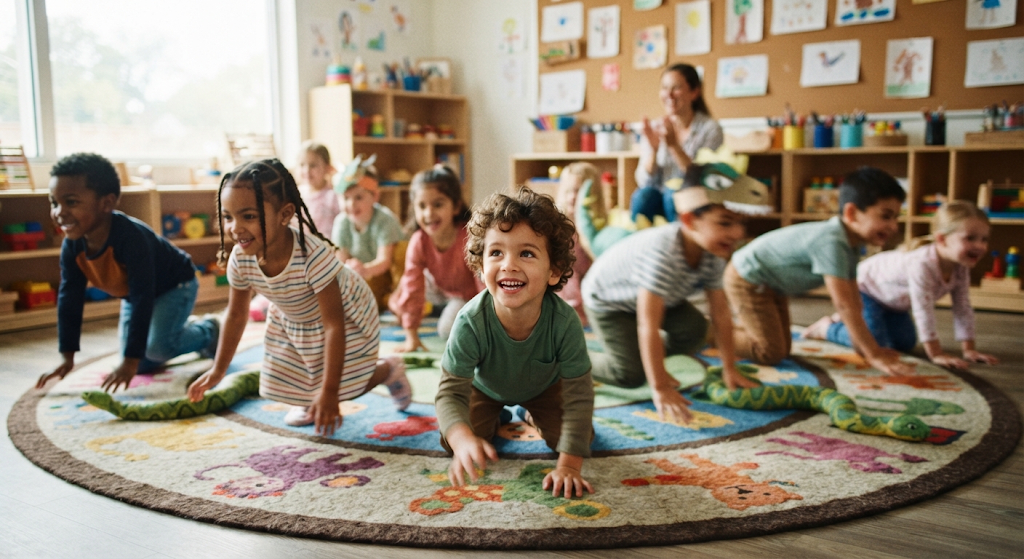
What children learn: How movement can help release big feelings safely.
What you need: Open floor space.
How to do it:
- Suggest an animal (bear, crab, frog, snake).
- Move around the room like that animal for 30–60 seconds.
- Pause and notice how the body feels afterward.
Teacher/Parent Example: “Let’s stomp like bears for a minute and see how our bodies feel after.”
Best for: Ages 3–8, home and classroom.
Why it helps: Physical movement can help discharge built-up energy from strong emotions.
Activity 7: Squeeze and Release
What children learn: To notice tension in the body and let it go on purpose.
What you need: None.
How to do it:
- Ask the child to make tight fists and squeeze for five seconds.
- Release the fists and shake out the hands.
- Repeat with shoulders, then whole body.
Teacher/Parent Example: “Squeeze your hands tight like you’re squeezing a lemon, then let go.”
Best for: Ages 4–8, home and classroom.
Why it helps: Teaches children the physical difference between tension and relaxation.
Activity 8: Sensory Calm Bottle
What children learn: To use focused attention as a way to settle down.
What you need: A clear bottle, water, glitter or sequins, glue.
How to do it:
- Fill the bottle with water and glitter, then seal it shut.
- Shake the bottle and watch the glitter swirl.
- Encourage slow breathing while watching it settle.
Teacher/Parent Example: “Let’s shake the calm bottle and watch until all the glitter settles.”
Best for: Ages 3–7, home and classroom.
Why it helps: Gives eyes and hands something calming to focus on during a strong feeling.
Activity 9: Storytime Feelings Check
What children learn: To identify emotions in characters, which builds empathy and self-awareness.
What you need: Any picture book.
How to do it:
- Pause at key moments in the story.
- Ask, “How do you think this character feels right now?”
- Ask what the character could do about that feeling.
Teacher/Parent Example: “How do you think she felt when her friend didn’t share?”
Best for: Ages 3–8, home and classroom.
Why it helps: Practising with a character’s feelings is often easier than starting with one’s own.
Activity 10: Puppet Problem-Solving
What children learn: To practise handling tricky social moments in a low-pressure way.
What you need: Two simple puppets or stuffed animals.
How to do it:
- Act out a common situation (one puppet takes the other’s toy).
- Ask the child how each puppet might feel.
- Ask the child to help the puppets solve the problem.
Teacher/Parent Example: “Oh no, Bear took Rabbit’s crayon! How do you think Rabbit feels? What could Bear do?”
Best for: Ages 3–7, home and classroom.
Why it helps: Role-play gives children safe practice before they face the real situation.
Activity 11: Draw Your Feeling
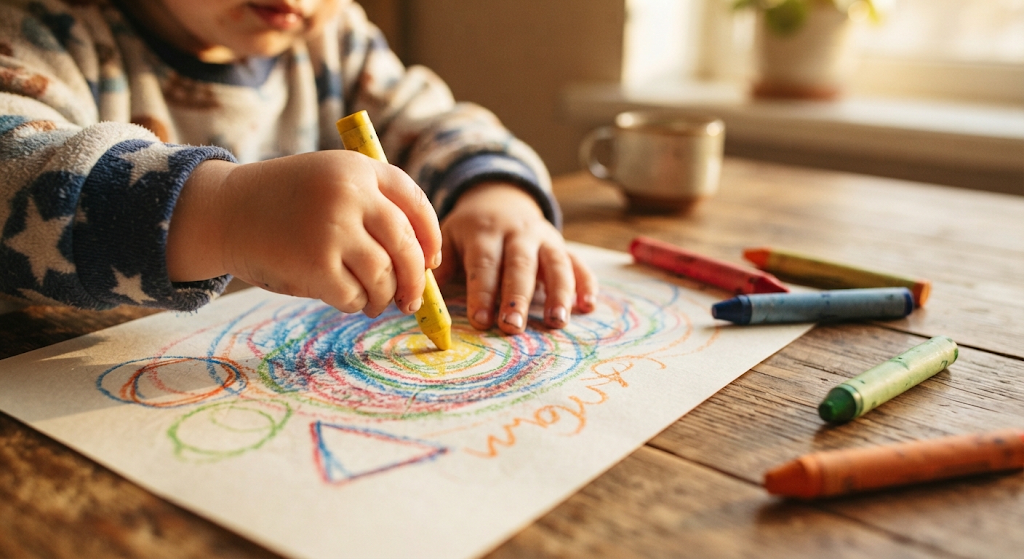
What children learn: To express emotions through art when words are hard to find.
What you need: Paper and crayons or markers.
How to do it:
- Ask the child to draw how they feel right now, using colours or shapes.
- Ask them to describe the drawing if they want to.
- There is no “right” way to draw a feeling.
Teacher/Parent Example: “Can you draw what your mad feels like? It can be any colour or shape.”
Best for: Ages 3–8, home and classroom.
Why it helps: Drawing offers another outlet for children who struggle to explain feelings verbally.
Activity 12: Feelings Playlist
What children learn: How music can shift or match a mood.
What you need: A few songs of different tempos.
How to do it:
- Play an upbeat song and move around.
- Play a slow, gentle song and move slowly or sit quietly.
- Ask which song matched their mood, and which one helped them feel calmer.
Teacher/Parent Example: “Let’s try this slow song and see if it helps your body feel quieter.”
Best for: Ages 3–8, home and classroom.
Why it helps: Music can support mood shifts and gives children another calming tool to try.
Activity 13: Mindful Listening Jar
What children learn: To pay close attention to the present moment.
What you need: A bell, chime, or small instrument.
How to do it:
- Ring the bell once.
- Ask the child to listen quietly until they can no longer hear any sound.
- Raise a hand when the sound is gone.
Teacher/Parent Example: “Listen very carefully. Raise your hand when you can’t hear the bell anymore.”
Best for: Ages 4–8, home and classroom.
Why it helps: Builds a short, simple habit of quiet, focused attention.
Activity 14: Problem-Solving Robot
What children learn: A step-by-step way to think through a conflict.
What you need: None (optional: a simple robot puppet or drawing).
How to do it:
- Introduce a “robot” that only follows steps: Stop, Think, Choose, Try.
- When a problem comes up, walk through the steps together.
- Praise the child for trying each step, even if the first choice doesn’t work.
Teacher/Parent Example: “Let’s be like our problem-solving robot: stop, think, choose, try.”
Best for: Ages 4–8, home and classroom.
Why it helps: Gives children a memorable structure for working through conflicts.
Activity 15: Daily Feelings Check-In
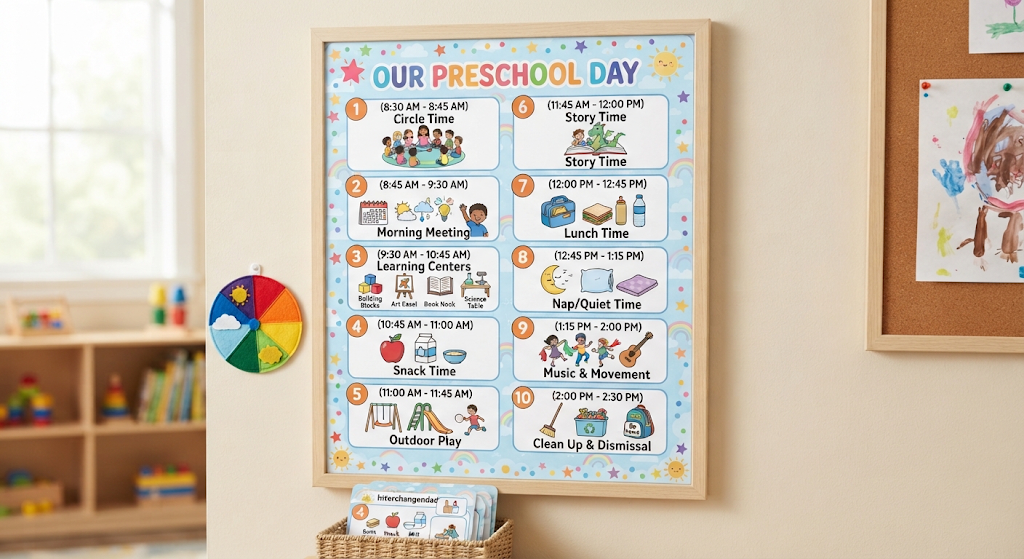
What children learn: To build the habit of noticing feelings regularly, not only during a crisis.
What you need: A feelings chart or simple checklist.
How to do it:
- At a set time each day (morning circle, dinner table), ask everyone to share one feeling word.
- Add a short reason if the child wants to share it.
- Keep it brief and judgment-free.
Teacher/Parent Example: “One word for how you’re feeling this morning?”
Best for: Ages 3–8, home and classroom.
Why it helps: Regular check-ins normalise talking about feelings before they become overwhelming.
Activity 16: Body Scan for Kids
What children learn: To notice where feelings show up in the body.
What you need: None.
How to do it:
- Ask the child to sit or lie down comfortably.
- Guide attention slowly from toes to head (“How do your feet feel? Your tummy? Your shoulders?”).
- Ask if any part feels tight, jumpy, or relaxed.
Teacher/Parent Example: “Let’s check in with our body. How do your shoulders feel right now?”
Best for: Ages 5–8, home and classroom.
Why it helps: Helps children connect physical sensations to emotions, an early step in noticing feelings.
Activity 17: Positive Self-Talk Cards
What children learn: Simple, encouraging phrases they can say to themselves during a hard moment.
What you need: Index cards with short phrases (“I can try again,” “Mistakes help me learn”).
How to do it:
- Read a few cards together and talk about what they mean.
- Practise saying one out loud during a calm moment.
- Remind the child of a card during a tricky moment.
Teacher/Parent Example: “Remember our card: ‘I can try again.’ Want to say it with me?”
Best for: Ages 5–8, home and classroom.
Why it helps: Gives children words to use instead of harsh self-criticism when things go wrong.
Activity 18: Choice Board for Coping Strategies
What children learn: To choose their own calming strategy from a set of options.
What you need: A simple board or card set with pictures of strategies (breathing, drawing, squeezing a toy, hugging a stuffed animal).
How to do it:
- Introduce the board when the child is calm.
- When upset, offer the board and ask, “Which one could help right now?”
- Support the child in trying their choice.
Teacher/Parent Example: “Take a look at your choice board. Which one do you want to try?”
Best for: Ages 4–8, home and classroom.
Why it helps: Giving children a choice increases their sense of control during a hard moment.
Activity 19: Friendship Repair Role-Play
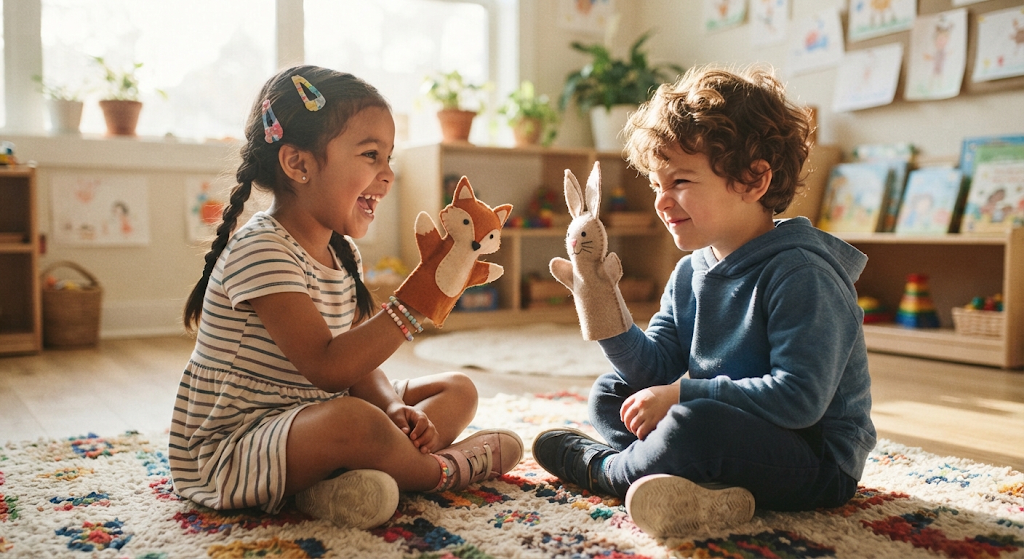
What children learn: How to repair a friendship after a disagreement.
What you need: None (optional: stuffed animals).
How to do it:
- Describe a common friendship conflict (grabbing a toy, not taking turns).
- Act out the situation together.
- Practise simple repair phrases: “I’m sorry,” “Can we try again?”
Teacher/Parent Example: “Let’s practise what you could say to your friend after the mix-up.”
Best for: Ages 4–8, home and classroom.
Why it helps: Builds confidence for handling real conflicts with peers.
Activity 20: Transition Timer Game
What children learn: To manage frustration around switching from one activity to another.
What you need: A visual timer or sand timer.
How to do it:
- Show the timer before a transition begins.
- Give a warning (“Five more minutes, then clean-up time”).
- Let the child watch the timer count down.
- Praise them for handling the transition, however it goes.
Teacher/Parent Example: “When the sand runs out, it will be time to put the blocks away.”
Best for: Ages 3–7, home and classroom.
Why it helps: Predictable warnings reduce the shock of sudden change, which often triggers frustration.
Activity 21: Losing Gracefully Game Night
What children learn: How to manage disappointment during a simple game.
What you need: Any short, simple board or card game.
How to do it:
- Play a short game together.
- Before starting, talk about how it might feel to lose.
- If the child loses, name the feeling and model a calm response.
- Praise any attempt at a calm reaction, even a small one.
Teacher/Parent Example: “That’s frustrating to lose. It happens to all of us. Want to play again?”
Best for: Ages 4–8, home and classroom.
Why it helps: Games offer frequent, low-stakes practice with disappointment.
Activity 22: The Worry Box
What children learn: A way to express and “let go” of a worry.
What you need: A small box, paper, pencil.
How to do it:
- Ask the child to draw or write about a worry.
- Fold the paper and put it in the box.
- Talk about the worry briefly, or simply let the box “hold” it for now.
Teacher/Parent Example: “Let’s put that worry in the box so it doesn’t feel so heavy.”
Best for: Ages 5–8, home and classroom.
Why it helps: Gives anxious feelings a concrete outlet instead of letting them build up unspoken.
Activity 23: Kindness Mirror
What children learn: To notice and name feelings while practising kind self-talk.
What you need: A small mirror.
How to do it:
- Ask the child to look in the mirror and notice their expression.
- Ask what feeling they see.
- Practise saying one kind thing to themselves in the mirror.
Teacher/Parent Example: “What do you notice on your face right now? What’s one kind thing you could say to yourself?”
Best for: Ages 5–8, home and classroom.
Why it helps: Connects self-awareness with gentle self-talk in a playful way.
Activity 24: Screen-Time Wind-Down Routine
What children learn: To manage frustration when a screen-time activity ends.
What you need: A visual or verbal warning system.
How to do it:
- Give a warning before screen time ends (“Two more minutes, then we turn it off”).
- Offer a simple next activity to move toward.
- Acknowledge the disappointment if it happens.
Teacher/Parent Example: “I know it’s hard to stop. Let’s turn it off together, then choose what’s next.”
Best for: Ages 3–8, home.
Why it helps: A predictable routine softens the abruptness of a transition many children find hard.
Activity 25: Gratitude and Good Moments Chat
What children learn: To notice positive feelings, not only difficult ones.
What you need: None.
How to do it:
- At the end of the day, ask the child to share one good moment.
- Ask how that moment felt in their body.
- Share one of your own good moments too.
Teacher/Parent Example: “What was one good part of your day? How did that feel?”
Best for: Ages 3–8, home and classroom.
Why it helps: Practising awareness of pleasant feelings builds the same noticing skills used for difficult ones.
How to Create a Calm Down Corner
A calm-down corner is one of the most useful emotional regulation tools for a classroom or a home, but it works best when it is set up thoughtfully.
Where to place it: Choose a quiet, low-traffic spot, away from the busiest part of the room, but still visible so an adult can keep an eye on it.
What materials to include:
- Soft cushions or a small rug
- A few emotion cards showing different feelings
- Simple breathing prompts (a laminated card with a picture of balloon breathing, for example)
- One or two calming books
- Soft sensory items, such as a stuffed animal, a stress ball, or a calm bottle
How children can use it: Children should be able to go there whenever they need a break, not only when an adult sends them. Introduce it as a place to feel better, not a place to be sent away to.
How adults should introduce it: Show the space during a calm moment, explain what each item is for, and practise visiting it together before a child ever needs it during a hard moment.
Important: A calm-down corner should never be used as punishment, timeout, or isolation. If it feels like a punishment, children will avoid it exactly when they need it most. It should always be framed as a helpful choice.
How Teachers Can Support Emotional Regulation in the Classroom
- Model calm behaviour. Children learn a great deal by watching how adults handle their own frustration. “I’m feeling frustrated, so I’m going to take a breath.”
- Name emotions out loud. “It looks like you’re feeling disappointed that it’s not your turn yet.”
- Use predictable routines. Consistent daily routines reduce the number of surprises that can trigger big reactions.
- Give transition warnings. “In five minutes, we’ll clean up and move to circle time.”
- Offer limited choices. “Would you like to sit on the rug or on a chair?” gives a sense of control without overwhelming choice.
- Teach calming strategies when children are already calm. Practising breathing or the calm corner during storytime works better than waiting for a meltdown to teach it for the first time.
- Use visual schedules. A picture-based daily schedule helps children anticipate what’s coming next.
- Validate feelings while maintaining boundaries. “I understand you’re angry. It’s still not okay to throw the blocks.”
- Give children time to recover. Rushing a child to “move on” before they’re ready can prolong the upset.
- Praise the use of appropriate coping strategies. “I noticed you took a breath before answering. That really helped.”
How Parents Can Support Emotional Regulation at Home
Big feelings tend to show up during predictable moments at home. Here are simple ways to respond in each one.
Tantrums: Stay nearby and calm. “You are really upset. I am here to help.” Wait until the storm passes before problem-solving.
Sibling disagreements: Name each child’s feeling before jumping to a solution. “You’re both upset about the toy. Let’s figure this out together.”
Bedtime: Keep a predictable wind-down routine and give warnings before lights-out. “In ten minutes, it will be time for pajamas.”
Getting ready for school: Use a visual checklist so mornings feel predictable rather than rushed and chaotic.
Sharing toys: Acknowledge how hard sharing can feel. “It’s hard to share your favourite toy. You can have it back in five minutes.”
Losing games: Model losing gracefully yourself, and name the feeling. “That’s disappointing. I know that feeling too.”
Frustration with homework: Break tasks into small steps and take short breaks when frustration builds. “Let’s take a breath, then try just this one part.”
Screen-time transitions: Give a warning before the screen turns off, and offer a next activity to move toward.
Avoid language that shames children for having feelings, such as “big kids don’t cry” or “you’re being dramatic.” These messages teach children to hide feelings rather than manage them. Read More
What to Say When a Child Is Having a Big Emotion
- “I can see that you are upset.”
- “It is okay to feel angry. It is not okay to hurt someone.”
- “Let’s take a moment together.”
- “Would you like help or some space?”
- “What could help your body feel calmer?”
- “I’m here with you.”
- “That sounds really disappointing.”
- “Your feelings make sense.”
- “Take your time. I’ll wait.”
- “Let’s figure this out together.”
- “It’s okay to feel this way.”
- “Can you show me with your body how big this feeling is?”
- “I believe you.”
- “What do you need right now?”
- “We can try again.”
Common Mistakes Adults Make When Teaching Emotional Regulation
- Expecting children to calm down immediately. Better alternative: give the feeling time to pass before problem-solving.
- Telling children to “stop crying.” Better alternative: acknowledge the feeling first, then offer comfort or a strategy.
- Using calming strategies as punishment. Better alternative: introduce the calm corner or breathing as a helpful choice, not a consequence.
- Teaching strategies only during meltdowns. Better alternative: practise strategies during calm, everyday moments.
- Giving too many instructions when a child is overwhelmed. Better alternative: use short, simple phrases and fewer words.
- Expecting children to regulate emotions independently too early. Better alternative: stay close and co-regulate, especially with younger children.
- Ignoring the child’s feelings while focusing only on behaviour. Better alternative: name and validate the feeling before addressing the behaviour.
How to Teach Emotional Regulation Step by Step
- Notice the emotion. Watch for body language, tone, or behaviour that signals a feeling is building.
- Name the emotion. “It looks like you’re feeling frustrated.”
- Validate the feeling. “That makes sense. That would frustrate me too.”
- Choose a coping strategy. Offer a choice board or ask, “What could help right now?”
- Reflect and problem-solve. Once calm, talk through what happened and what could work differently next time.
Example: A child is frustrated because their puzzle piece won’t fit. An adult notices the frustration building, says, “It looks like that piece is tricky,” validates with, “That’s frustrating when it won’t fit,” offers a short break or a breath, and afterward asks, “Want to try turning the piece a different way?”
Frequently Asked Questions
What is emotional regulation for children?
Emotional regulation is the ability to notice, understand, and manage feelings in a way that fits the situation. For young children, this is a developing skill, not something they are born knowing how to do. It grows gradually with practice, modeling, and support from caring adults over many years.
What are the best emotional regulation activities for young children?
The best activities are simple, playful, and practised regularly, not just during meltdowns. Activities like emotion cards, feelings thermometers, calm-down corners, breathing games, and role-play with puppets all help children build awareness and coping skills in a way that fits their age and attention span.
How do I teach my child to calm down?
Start by naming the feeling and staying calm yourself, since children often borrow an adult’s calm. Then offer a simple strategy, such as a breath, a squeeze toy, or a quiet corner. Practise the strategy during calm moments first so it feels familiar when a big feeling hits. Read More
What activities help children manage anger?
Movement-based activities like animal walks, squeeze and release, and balloon breathing can help release physical tension that often builds with anger. Naming the feeling and offering a safe way to express it, such as drawing or a calm corner, also helps. Read More
How can teachers help children regulate emotions?
Teachers can model calm behaviour, name emotions throughout the day, keep predictable routines, and teach coping strategies before they’re needed, not only during a crisis. Validating feelings while still holding clear boundaries helps children feel understood without removing structure.
What should I do when a child has a meltdown?
Stay calm, stay nearby, and avoid trying to reason or problem-solve until the child has settled. Simple, short phrases like “I’m here” are more helpful than long explanations. Once the child is calm, you can talk through what happened.
At what age do children learn emotional regulation?
Emotional regulation begins developing in toddlerhood and continues to grow through the preschool years, primary school, and beyond. Most young children still need significant adult support to manage big feelings, and that is completely normal and expected.
What is the difference between emotional regulation and emotional control?
Emotional regulation is about understanding and managing feelings in a healthy way, including expressing them appropriately. Emotional control can sometimes be confused with suppressing or hiding feelings altogether. The goal of regulation is not to stop feelings, but to help children experience and move through them safely.
Final Thoughts
Emotional regulation is not something young children master overnight, and it is not something they can learn through a single lesson or lecture. It is a skill built slowly, moment by moment, with plenty of patient practice and support from the adults around them.
The emotional regulation activities for young children shared in this article work best when they become a regular part of everyday life, not just a tool pulled out during a crisis. Try one or two activities this week, practise them when everyone is calm, and be patient with the process. Over time, these small, consistent moments add up to children who feel more confident handling life’s big feelings.