
Social and Emotional Development: Step by Step Guide
A complete, evidence-based guide to social and emotional development in children ages 2–8, with milestones, activities, and ready-to-use strategies for parents and teachers.
Every parent has watched a child melt down over a broken cracker, and every teacher has watched two four-year-olds fight over the same red crayon while five identical crayons sit untouched nearby. These moments aren’t signs that something is wrong. They’re signs that social and emotional development is happening in real time, right in front of you.
Social and emotional development is the process through which children learn to understand their feelings, manage their behavior, build relationships, and make thoughtful decisions. It’s not a “soft skill” that competes with academics it’s the foundation underneath them. A child who can’t calm down after a disappointment can’t focus on a math worksheet. A child who can’t read a friend’s facial expression struggles to navigate the playground, let alone a classroom discussion.
This guide is built to be used, not just read. It walks through what social and emotional development actually looks like at each age, what to do when things go sideways (tantrums, biting, shyness, defiance), and exactly which activities, scripts, and routines to use at home or in the classroom starting today.
A quick note before we dive in: one of the biggest misconceptions about social and emotional development is that it happens naturally, without adult input, or that it’s the school’s job, not the family’s (or vice versa). In reality, these skills are taught the same way reading and counting are taught through modeling, repetition, and lots of patient practice. Parents and teachers are equally essential, and consistency between home and school is what makes the learning stick.
What Is Social and Emotional Development?
Social and emotional development is usually broken into five interconnected skill areas. Most educational psychologists (including the framework used by CASEL, the Collaborative for Academic, Social, and Emotional Learning) organize it this way:
Self-Awareness
The ability to recognize one’s own emotions, thoughts, and how they influence behavior.
Example: A five-year-old who says, “I’m frustrated because I can’t get my shoe on,” is demonstrating self-awareness. A toddler who simply screams and throws the shoe is still developing that same skill.
Self-Regulation
The ability to manage emotions, impulses, and behaviors in different situations.
Example: A child who wants to grab a toy but instead asks, “Can I have a turn?” is practicing self-regulation.
Social Awareness
The ability to understand and respect the perspectives of others, including people from different backgrounds.
Example: Noticing that a classmate looks sad at drop-off and asking, “Are you okay?”
Relationship Skills
The ability to build and maintain healthy relationships through communication, cooperation, and conflict resolution.
Example: Two children negotiating who goes first on the slide instead of pushing.
Responsible Decision-Making
The ability to make constructive choices about personal behavior based on ethical standards, safety, and social norms.
Example: A six-year-old choosing to tell a teacher about a broken window rather than hiding it.
These five areas don’t develop in isolation they build on each other. Self-awareness usually comes first (a toddler learning to name “mad” or “sad”), and responsible decision-making comes last, since it depends on all the others being at least partially in place.
Why Social and Emotional Development Matters
It’s tempting to treat social-emotional learning as a “nice extra” next to reading and math. The research says otherwise.
Academic achievement. A well-known meta-analysis of over 200 school-based programs found that students who received social-emotional instruction showed an 11-percentile-point gain in academic achievement compared to peers who didn’t. Emotional regulation and attention are closely linked a dysregulated brain has a hard time learning anything.
Confidence and self-esteem. Children who can name their feelings and recover from setbacks develop a stronger sense of “I can handle this,” which shows up later as resilience and self-esteem.
Communication skills. Social-emotional skills are the scaffolding for language use in real contexts negotiating, apologizing, asking for help, and explaining a problem all draw on this foundation.
Problem-solving abilities. Kids who understand cause and effect in social situations (“If I grab the toy, she’ll cry and we can’t play”) make better decisions with less adult intervention over time.
Mental well-being. Early emotional regulation skills are protective factors against anxiety and behavioral difficulties later in childhood and adolescence.
Relationship building. Friendship skills learned at age four don’t just help on the playground — they’re the same skills used in a marriage, a workplace, and a friendship group decades later.
Social and Emotional Development Milestones by Age
Every child develops at their own pace, and the ranges below are general guidelines, not strict deadlines. Use them to understand the general trajectory, not to compare one child against anotherAges 2–3 Years
Expected behaviors: Parallel play (playing alongside, not necessarily with, other children), strong displays of independence (“I do it!”), frequent tantrums as language lags behind big feelings.
Social milestones:
- Begins to imitate other children’s play
- Shows interest in other children but plays mostly solo or side-by-side
- Starts to show possessiveness over toys and people
Emotional milestones:
- Displays a wide range of emotions (joy, anger, fear, sadness)
- Struggles significantly with transitions
- Begins to show empathy in simple ways (patting a crying friend)
Communication skills:
- Uses 2–3 word phrases to express needs
- Beginning to use words like “mine,” “no,” and “mad”
Activities:
- Naming emotions during storytime (“The bear looks sad here — why?”)
- Simple turn-taking games (rolling a ball back and forth)
- Mirror games (“Can you make a happy face? A surprised face?”)
Warning signs to watch for: No interest in other children by age 3, no meaningful eye contact, extreme and prolonged distress at every minor transition, complete absence of pretend play.
Ages 3–4 Years
Expected behaviors: Increased interest in playing with other children, beginning cooperative play, growing vocabulary for feelings.
Social milestones:
- Engages in simple cooperative play (building a block tower together)
- Begins to take turns with support
- Starts forming preferences for certain playmates
Emotional milestones:
- Can label basic emotions (happy, sad, mad, scared) in self and others
- Tantrums may still occur but begin to shorten in duration with support
- Shows early signs of pride in accomplishments
Communication skills:
- Uses full sentences to express feelings (“I don’t want to share right now”)
- Begins asking “why” questions about others’ behavior and feelings
Activities:
- Feelings charades
- “How do you think he feels?” during picture books
- Simple cooperative games like rolling dice and passing turns
Warning signs: Persistent inability to engage in any shared play, extreme aggression without any identifiable trigger, no verbal expression of feelings by age 4.
Ages 4–5 Years
Expected behaviors: More sustained cooperative and imaginative play, growing awareness of rules and fairness, increased frustration tolerance.
Social milestones:
- Plays cooperatively in small groups
- Begins to understand and follow simple game rules
- Shows preference for specific friends
Emotional milestones:
- Can identify a wider range of emotions (excited, worried, embarrassed)
- Starts to use some self-calming strategies independently
- Understands that others have different feelings from their own
Communication skills:
- Can explain why they feel a certain way
- Begins to use words to resolve minor conflicts (“Can I have it after you?”)
Activities:
- Emotion matching card games
- Role-playing common conflicts (“What do you do if someone grabs your toy?”)
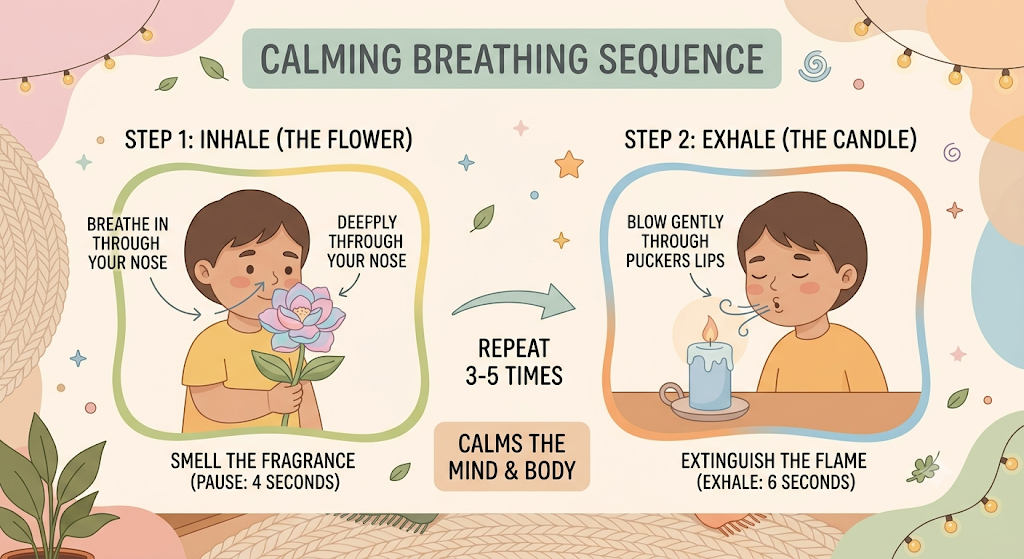
- Calm-down breathing practice (“smell the flower, blow out the candle”)
Warning signs: Consistent inability to follow simple 2-step social rules, ongoing physical aggression as a first response to conflict, no interest in friendships.
Ages 5–6 Years
Expected behaviors: Increasing independence in managing emotions, beginning of true friendships, heightened sense of fairness and rule-following.
Social milestones:
- Forms genuine friendships with preferred playmates
- Understands and enforces game rules (“That’s not fair, you skipped your turn”)
- Begins to include others and show basic teamwork
Emotional milestones:
- Uses words instead of physical actions to express frustration in most situations
- Shows growing frustration tolerance for challenging tasks
- Starts to understand consequences of actions on others’ feelings
Communication skills:
- Can describe conflicts with some detail (“She took it and I asked for it back and she said no”)
- Begins negotiating compromises independently
Activities:
- Circle time discussions on kindness and fairness
- “Feelings thermometer” to rate emotion intensity
- Buddy systems for younger or shy classmates
Warning signs: Ongoing inability to sustain any friendship, chronic difficulty following classroom routines, excessive anxiety that interferes with participation.
Ages 6–8 Years
Expected behaviors: Growing capacity for self-control, deeper friendships, developing moral reasoning, increased sensitivity to peer opinion.
Social milestones:
- Maintains stable friendships over time
- Understands group dynamics (teams, group projects)
- Begins to navigate peer pressure and social comparison
Emotional milestones:
- Can identify complex emotions (jealousy, disappointment, pride)
- Uses a range of self-regulation strategies independently
- Begins to understand delayed gratification
Communication skills:
- Can articulate both sides of a conflict
- Uses “I” statements with minimal prompting (“I feel left out when…”)
Activities:
- Journaling about feelings
- Group problem-solving challenges (build a structure together with limited materials)
- Structured debate or discussion circles on fairness and rules
Warning signs: Persistent social withdrawal, ongoing difficulty maintaining any friendships, significant emotional outbursts disproportionate to the trigger, signs of chronic anxiety or low mood.
Common Behavioral Challenges and Practical Solutions
Tantrums
Possible causes: Overwhelm, hunger, fatigue, inability to express a need verbally, desire for control.
Warning signs it’s more than typical: Tantrums lasting well over 20–25 minutes regularly, self-injury during tantrums, tantrums persisting well past age 5 with high frequency.
Practical solutions:
- Stay calm and nearby; don’t try to reason during the peak of the tantrum
- Name the emotion once things start to settle: “You’re really upset that we had to leave the park.”
- Offer a calm-down option once the child is receptive (see the Calming Corner section below)
Home strategies: Keep a predictable routine, offer choices (“Do you want to leave in 2 minutes or 5?”), avoid tantrums-as-negotiation by holding firm boundaries calmly.
Classroom strategies: Provide a designated calm-down space, use visual timers for transitions, keep a consistent daily schedule.
Aggressive Behavior (Hitting, Biting, Pushing)
Possible causes: Limited verbal skills, frustration, sensory overload, imitation of behavior seen elsewhere.
Warning signs: Aggression as the first response to any frustration past age 5, aggression toward animals, lack of any remorse.
Practical solutions:
- Address immediately and calmly: “Hitting hurts. We use words.”
- Redirect to an acceptable action (“Squeeze this pillow instead”)
- Teach the replacement phrase in advance (“Stop, I don’t like that”)
Home strategies: Model calm conflict resolution between adults in the home, avoid physical discipline (which models aggression as a solution), reinforce gentle touch during calm moments.
Classroom strategies: Seat aggressive-prone children near calm peers, use social stories about hands being for helping, praise gentle interactions immediately when they happen.
hHow to Manage Challenging Behaviour in Early Years
Separation Anxiety
Possible causes: Developmental stage (common ages 1–3, can resurface at transitions like starting school), change in routine, insecure attachment experiences.
Warning signs: Persisting well past the expected adjustment period (2–3 weeks into a new routine), physical symptoms (stomachaches, vomiting) tied specifically to separation, complete refusal to attend school.
Practical solutions:
- Create a consistent, brief goodbye ritual and stick to it
- Never sneak away without saying goodbye this erodes trust
- Send a comfort object or a small note in a pocket
Home strategies: Practice short separations before longer ones, talk positively about the return (“I’ll pick you up right after snack time”).
Classroom strategies: Give the child a special job at arrival time to ease the transition, keep a consistent staff member for greeting, allow a transitional object.
Shyness / Social Withdrawal
Possible causes: Temperament, limited social exposure, past negative social experience, sensory sensitivity in group settings.
Warning signs: Complete avoidance of all peer interaction, physical symptoms of anxiety around peers, regression in previously acquired social skills.
Practical solutions:
- Never force performance (“Say hi!”) instead, model the interaction yourself
- Start with one-on-one playdates rather than large groups
- Praise small steps (“I saw you wave at Maya today!”)
Home strategies: Role-play common social scenarios at home, read books featuring shy characters who find their voice.
Classroom strategies: Pair with one warm, patient peer rather than large groups, give advance notice before group activities, offer a quiet role in group work.
Low Self-Confidence
Possible causes: Frequent criticism or comparison, learning difficulties, perfectionism, limited opportunities for independent success.
Practical solutions:
- Praise effort and process, not just outcome (“You worked really hard on that”)
- Give age-appropriate independent responsibilities
- Avoid comparing siblings or classmates
Home strategies: Create a “proud of myself” jar for daily wins, however small.
Classroom strategies: Rotate classroom jobs so every child experiences responsibility and success.
Difficulty Sharing
Possible causes: Developmentally normal below age 4, attachment to specific objects, limited experience with turn-taking.
Practical solutions:
- Use visual timers for turn-taking (“You have 3 minutes, then it’s Sam’s turn”)
- Avoid forcing sharing of a specially meaningful item
- Praise sharing moments specifically and immediately
Home strategies: Practice turn-taking with low-stakes items (drawing markers) before high-stakes ones (a favorite toy).
Classroom strategies: Provide duplicates of popular toys where possible, use a visible sign-up sheet for high-demand equipment.
Defiance
Possible causes: Testing limits (developmentally normal), desire for control, inconsistent boundaries, unmet needs (hunger, fatigue).
Practical solutions:
- Offer limited choices instead of open-ended demands (“Blue cup or red cup?”)
- Stay calm and matter-of-fact; avoid power struggles
- Follow through consistently on stated consequences
Home strategies: Involve the child in creating simple household rules so they have some ownership.
Classroom strategies: Use consistent, predictable consequences across all staff, avoid public confrontations redirect privately when possible.
Frustration Intolerance
Possible causes: Task too difficult, perfectionism, limited coping strategies, fatigue.
Practical solutions:
- Break tasks into smaller steps
- Teach a simple frustration script: “This is hard. I can take a break and try again.”
- Model your own frustration management out loud
Home strategies: Praise persistence explicitly (“You didn’t give up even though it was tricky”).
Classroom strategies: Offer a “take a break” card system children can use independently.
How to Manage Challenging Behaviour in Early Years
Excessive Screen Time
Possible causes: Convenience, lack of alternative engaging activities, using screens to manage difficult emotions.
Practical solutions:
- Set clear, consistent daily limits and stick to them
- Offer engaging alternatives at the same time each day
- Co-view when possible and discuss content together
Home strategies: Create screen-free zones (mealtimes, bedrooms) and screen-free times (first hour after school).
Classroom strategies: Limit screen use to intentional, teacher-guided instructional moments only.
How to Reduce Screen Time in Children: 25 Proven Ideas
Difficulty Following Instructions
Possible causes: Instructions too complex or multi-step, attention difficulties, not hearing/understanding the instruction, testing boundaries.
Practical solutions:
- Give one instruction at a time for younger children
- Get down to eye level and confirm understanding
- Use visual supports alongside verbal instructions
Home strategies: Use consistent daily routines so instructions become predictable rather than novel each time.
Classroom strategies: Pair verbal instructions with visual schedules and gestures.
Step by Step Emotional Regulation Strategies
Deep Breathing Exercises
- Flower and candle breathing: Breathe in through the nose (smell the flower) for 4 counts, out through the mouth (blow the candle) for 4 counts.
- Balloon belly: Lie down, place a small stuffed animal on the belly, and watch it rise and fall with each breath.
- Star breathing: Trace a star shape with a finger, breathing in on each upward line and out on each downward line.
Mindfulness Activities
- Five senses check-in: Name one thing you can see, hear, smell, touch, and (if safe) taste.
- Body scan: Starting at the toes, gently tense and release each muscle group.
- Mindful snack time: Eat one small snack slowly, noticing texture, smell, and taste.
Calming Corners
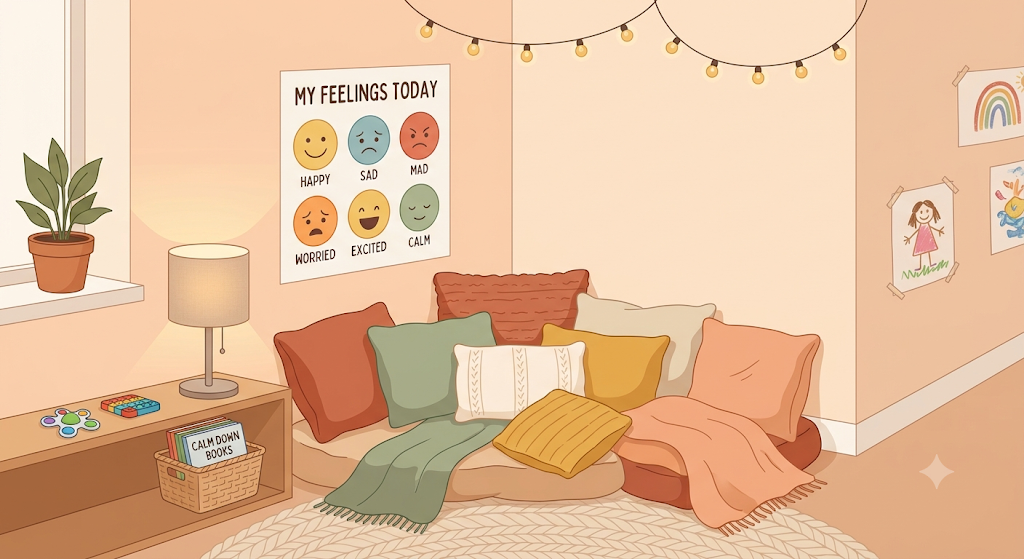
Set up a small, cozy space with soft seating, a few calming visuals (a feelings chart, a breathing poster), a small basket of sensory tools (stress ball, soft fabric, small fidget items), and a visual timer. Introduce it before it’s needed, during a calm moment, so the child associates it with regulation rather than punishment.
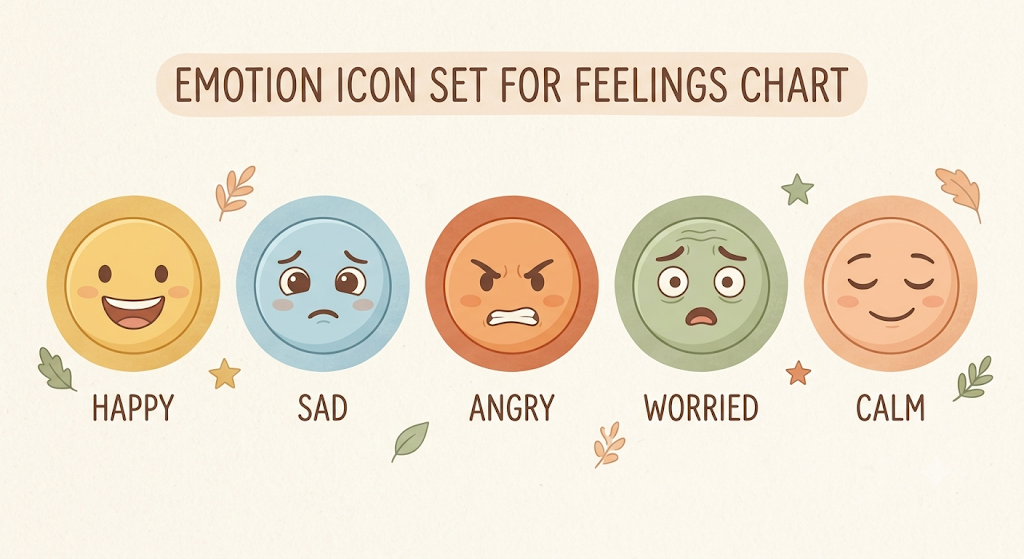
Feelings Charts
A simple chart with faces representing a range of emotions (happy, sad, angry, worried, excited, calm) that a child can point to throughout the day. Charting feelings across a week can reveal patterns (e.g., always anxious before Mondays) worth discussing.
Storytelling Activities
Use picture books featuring characters who experience big emotions and work through them. Pause to ask: “How do you think she feels? What could he do instead?”
Positive Reinforcement
Catch children being regulated and label it specifically: “You were really frustrated with that puzzle, and you took a breath instead of throwing it. That’s exactly the kind of self-control we’re working on.”
Practical Classroom Strategies
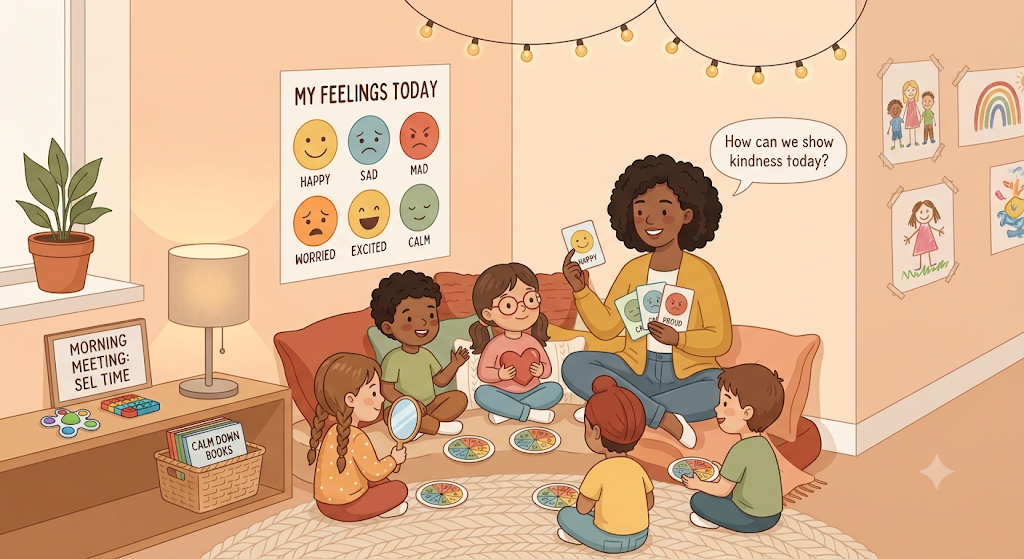
Morning meetings. A short daily gathering (10–15 minutes) where children greet each other, share something, and preview the day. Builds belonging and predictability.
Role-playing. Act out common social scenarios (asking to join a game, apologizing, handling disappointment) so children have rehearsed scripts ready for real situations.
Partner activities. Structured pair work (e.g., “Turn and tell your partner about your weekend”) builds low-stakes practice in listening and turn-taking.
Circle time. Regular group discussions on topics like kindness, fairness, and feelings, using open-ended questions rather than lectures.
Visual schedules. Picture-based daily schedules reduce anxiety around transitions and build independence.
Classroom rules. Co-create a short list (3–5 rules) with the class, stated positively (“We use kind words” rather than “No mean words”).
Positive discipline techniques. Focus on teaching rather than punishing: natural consequences, problem-solving together, and repair over punishment (e.g., helping fix what was broken rather than only losing a privilege).
Home Based Activities (20+ Ready to Use Ideas)
| # | Activity | Skill Targeted | How to Do It |
|---|---|---|---|
| 1 | Emotion cards | Self-awareness | Match faces to feeling words during a quiet moment |
| 2 | Puppet play | Social awareness | Act out a conflict using puppets, then discuss solutions |
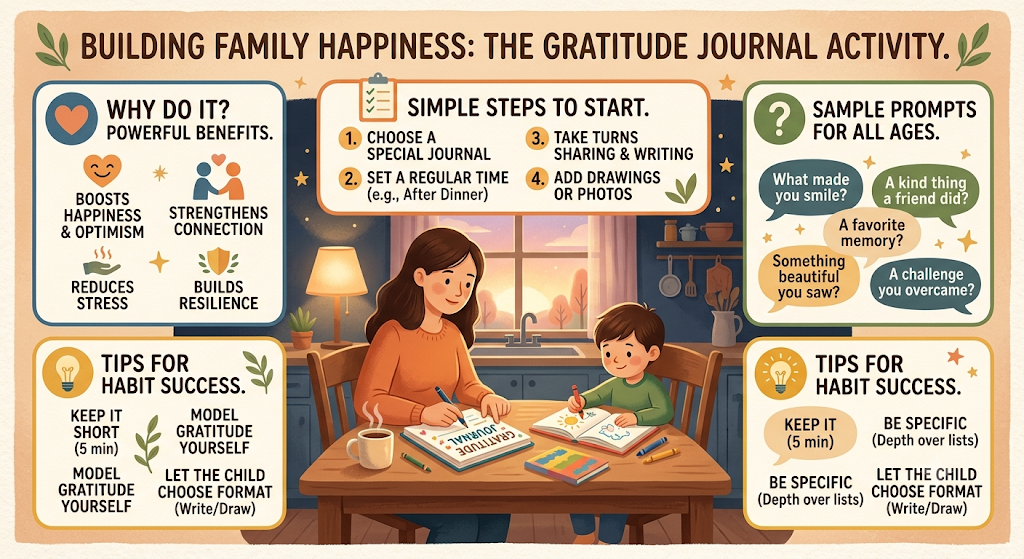
| 3 | Gratitude journal | Self-awareness | Draw or write one good thing each night |
| 4 | Mirror activities | Self-awareness | Make and name different facial expressions together |
| 5 | Breathing exercises | Self-regulation | Practice flower-and-candle breathing before bed |
| 6 | Storytelling | Empathy | Read a book and discuss characters’ feelings |
| 7 | Family meetings | Relationship skills | Weekly 10-minute check-in on wins and worries |
| 8 | Feelings charades | Self-awareness | Act out an emotion for others to guess |
| 9 | Calm-down jar | Self-regulation | Shake glitter jar and watch it settle while breathing |
| 10 | Kindness challenge | Social awareness | Do one kind thing each day and share it at dinner |
| 11 | Role-play scripts | Conflict resolution | Practice “Can I have a turn?” before playdates |
| 12 | Feelings thermometer | Self-awareness | Rate emotion intensity on a scale of 1–5 |
| 13 | Sensory bin calm-down | Self-regulation | Provide rice, beans, or sand for tactile calming |
| 14 | Compliment circle | Relationship skills | Each family member gives one compliment at dinner |
| 15 | Pretend restaurant | Social skills | Practice turn-taking and polite requests in play |
| 16 | “What would you do?” cards | Decision-making | Discuss hypothetical social scenarios |
| 17 | Worry box | Self-regulation | Write or draw worries and “post” them to release |
| 18 | Team chores | Relationship skills | Complete a task together requiring cooperation |
| 19 | Feelings collage | Self-awareness | Cut out magazine faces showing different emotions |
| 20 | Bedtime reflection | Self-awareness | Ask “What made you happy today? What was hard?” |
| 21 | Apology practice | Relationship skills | Rehearse a simple, genuine apology script |
| 22 | Community helper visits | Social awareness | Discuss feelings and roles of people who help others |
Teaching Communication Skills
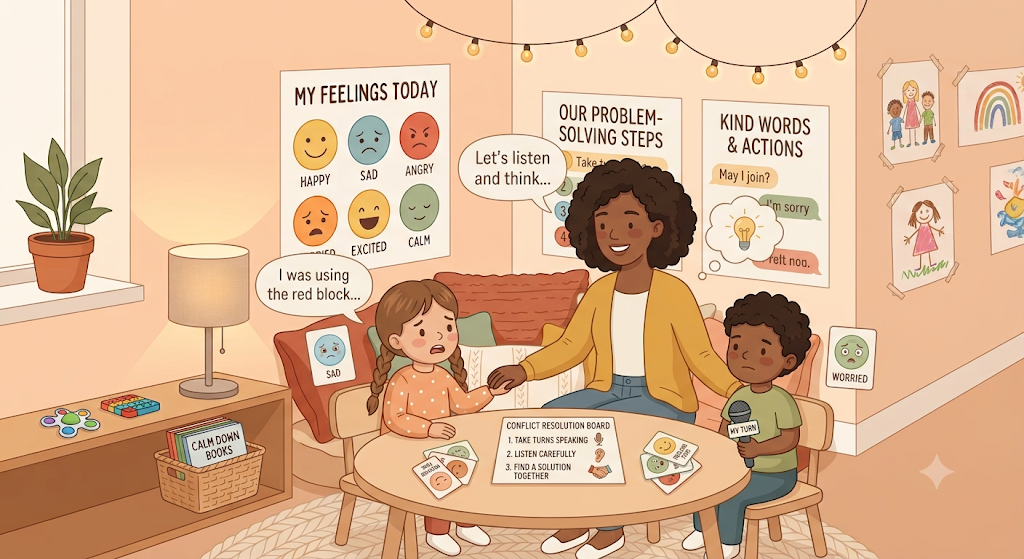
Active listening. Teach children to look at the speaker, wait for their turn, and repeat back what they heard: “So you’re saying you wanted to go first?”
Expressing emotions. Provide a simple sentence frame: “I feel ___ because ___.” Practice it during calm moments so it’s available during hard ones.
Using respectful language. Model please, thank you, and “excuse me” consistently children absorb tone as much as vocabulary.
Building confidence. Give children real opportunities to speak up (ordering their own food, answering the door) so confidence builds through actual practice.
Asking for help. Teach a specific phrase (“I need help, please”) and praise its use immediately, so asking for help feels safe rather than embarrassing.
Teaching Conflict Resolution Skills
A simple five-step framework works well for children ages 4 and up:
- Recognize emotions. “How are you feeling right now?”
- Identify the problem. “What happened?”
- Listen carefully. Each child gets a turn to speak without interruption.
- Suggest solutions. “What could we do to fix this?”
- Compromise respectfully. Choose a solution together, even if it’s not either child’s first choice.
Sample script for a toy conflict:
- Adult: “It looks like you both want the truck. Sam, what happened?”
- Sam: “I had it first and she took it.”
- Adult: “Maya, what happened?”
- Maya: “I wanted a turn.”
- Adult: “So Sam had it first, and Maya wants a turn. What’s an idea that could work for both of you?”
- Sam: “She can have it after I finish this one lap.”
- Adult: “That sounds fair. Maya, does that work?”
This script teaches children that conflicts have solutions they can generate themselves, with adult support rather than adult-imposed verdicts.
Ready to Use Daily Routines
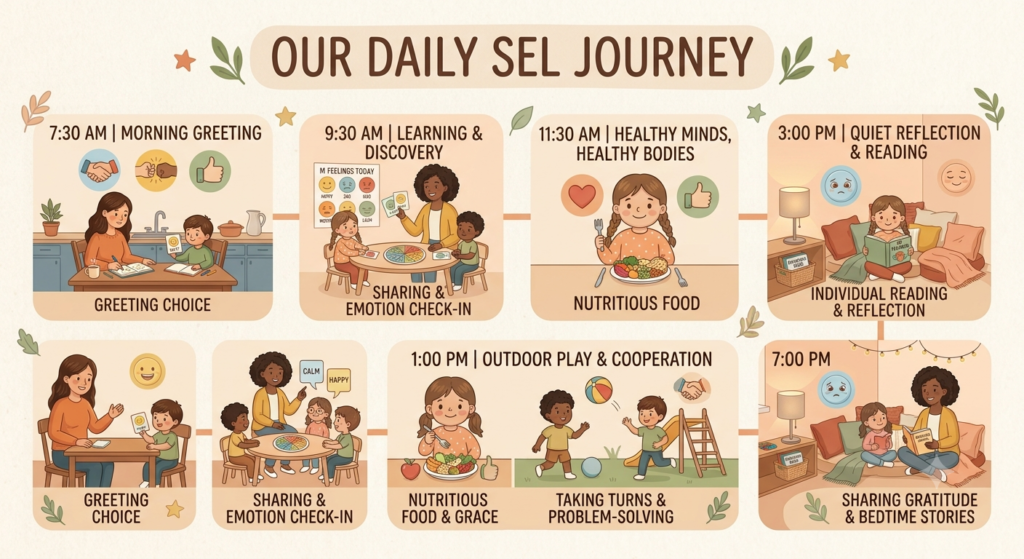
Morning routine: Consistent wake-up time → visual checklist (dress, brush teeth, eat) → one minute of connection (a hug, a quick check-in) → calm goodbye ritual.
Learning time routine: Brief settling activity (breathing or stretching) → clear task expectations stated aloud → built-in movement break every 20–30 minutes for younger children.
Mealtime routine: Sit together when possible → one open-ended question per person (“best part of your day?”) → model table manners without excessive correction during the meal itself.
Playtime routine: Offer a mix of independent and cooperative play daily → provide a 5-minute warning before playtime ends → involve the child in cleanup as a shared task, not a punishment.
Bedtime routine: Consistent sequence (bath, book, brief reflection, lights out) → use the reflection moment for a simple emotional check-in → keep the sequence identical night to night for predictability.
A Complete Weekly Social and Emotional Learning Plan
| Day | Focus Skill | Activity | Discussion Prompt |
|---|---|---|---|
| Monday | Self-awareness | Feelings chart check-in | “What’s one word for how you feel today?” |
| Tuesday | Empathy | Storytime with feelings discussion | “How do you think the character felt?” |
| Wednesday | Self-regulation | Breathing practice + calm corner intro | “What helps you feel calm?” |
| Thursday | Relationship skills | Partner cooperative game | “What was tricky about working together?” |
| Friday | Conflict resolution | Role-play a common classroom conflict | “What could we do differently next time?” |
| Weekend | Family connection | Family meeting or gratitude sharing | “What are you proud of this week?” |
Frequently Asked Questions
What are social and emotional skills?
Social and emotional skills are the abilities children use to understand and manage their emotions, build relationships, show empathy, and make thoughtful decisions. They include self-awareness, self-regulation, social awareness, relationship skills, and responsible decision-making.
Why is emotional regulation important?
Emotional regulation allows children to manage strong feelings without being overwhelmed by them. Without it, children struggle to focus, learn, and maintain relationships, since a dysregulated nervous system makes rational thinking and learning very difficult in the moment.
How can parents support emotional development?
Parents can model calm emotional expression, name feelings out loud, maintain predictable routines, and give children regular, low-stakes practice with problem-solving and self-expression.
How can teachers improve children’s social skills?
Teachers can build in structured opportunities for cooperative play, use morning meetings and circle time consistently, teach conflict resolution scripts directly, and reinforce positive social behavior immediately when it happens.
When should parents seek professional help?
If a child shows persistent, intense difficulties well beyond what’s typical for their age such as complete social withdrawal, ongoing severe aggression, extreme anxiety that interferes with daily functioning, or a loss of previously acquired skills it’s worth consulting a pediatrician, child psychologist, or early childhood specialist for an evaluation.https://www.naeyc.org/
Can social and emotional skills be taught, or are they just personality?
While temperament plays a role in how a child expresses emotions, the underlying skills naming feelings, calming down, resolving conflict can absolutely be taught and strengthened through consistent modeling and practice, much like any other skill.
What’s the difference between discipline and positive discipline?
Traditional discipline often focuses on punishment after the fact. Positive discipline focuses on teaching the skill the child is missing regulation, communication, problem-solving so the underlying behavior improves over time, not just in the moment.
Conclusion
Social and emotional development isn’t a single lesson or a single conversation it’s built through thousands of small, repeated moments: a named feeling, a modeled apology, a calm breath taken together, a conflict worked through instead of shut down.
Progress won’t be a straight line. There will be days that feel like enormous steps backward a tantrum in the grocery store, a bitten friend, a refusal to leave a parent’s side. These moments aren’t failures of the child or the adult. They’re simply part of how this particular kind of learning happens.
What matters most is consistency: the same calm response, the same routines, the same patient modeling, repeated over months and years. With patience, empathy, and the practical tools in this guide, every child can build the social and emotional foundation they need not just to succeed in school, but to navigate relationships and challenges for the rest of their life.
Checklist: Supporting Social and Emotional Development
Daily habits:
- [ ] Named at least one feeling out loud today (mine or theirs)
- [ ] Modeled a calm response to a frustrating moment
- [ ] Gave the child a chance to solve a small problem independently
- [ ] Followed the established routine for transitions
- [ ] Offered specific praise for a positive social or emotional moment
Weekly habits:
- [ ] Read a book together that touches on feelings or friendship
- [ ] Practiced a calming strategy together before it was urgently needed
- [ ] Held a family meeting or classroom circle time
- [ ] Reviewed one conflict together and discussed what could go differently next time
Monthly check-in:
- [ ] Compared current behavior to typical milestones for the child’s age
- [ ] Noted any patterns or concerns worth discussing with a teacher or pediatrician
- [ ] Celebrated visible growth, however small