
Discover the benefits, strategies, activities, and games for play based learning in early years. Expert guide for educators and parents supporting young children.
Introduction to Play Based Learning in Early Years
What Is Play Based Learning and Why Does It Matter
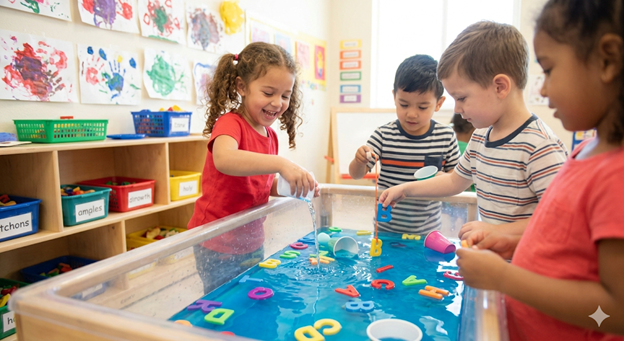
Play based learning in early years is a child-centred educational approach that uses play as the primary vehicle for developing cognitive, social, emotional, and physical skills in children aged birth to eight years. Rather than sitting children at desks with worksheets, this approach recognises that young children learn most effectively through hands-on exploration, imagination, and natural curiosity.
According to the United Nations Convention on the Rights of the Child, play is recognised as a fundamental right of every child. This places play not as a luxury but as an essential component of healthy development. Early years settings that embrace play based approaches report higher levels of engagement, reduced anxiety, and improved outcomes across multiple developmental domains.
The Science Behind Learning Through Play in Early Childhood
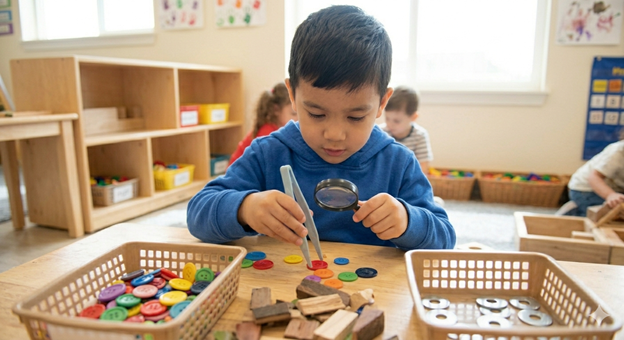
Neuroscientific research strongly supports play as a mechanism for brain development. A landmark study published in Pediatrics by the American Academy of Pediatrics (2018) confirmed that play promotes the development of executive function, creativity, and social-emotional skills. During play, the prefrontal cortex responsible for planning, decision-making, and impulse control is highly active, laying critical neural pathways that support lifelong learning.
Research by Professor Kathy Hirsh-Pasek of Temple University demonstrates that guided play produces stronger learning outcomes than direct instruction alone in children under six. Furthermore, the OECD’s Starting Strong reports consistently highlight play-based pedagogy as a hallmark of high-quality early childhood education systems worldwide, including those in Finland, Sweden, and New Zealand.
How Play Based Learning Shapes Cognitive and Social Development
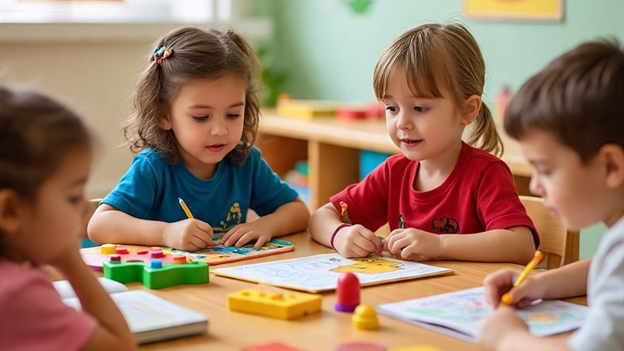
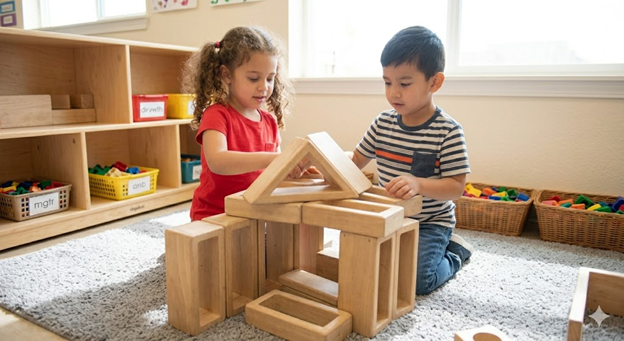
When children engage in play, they are simultaneously practising literacy, numeracy, problem-solving, and social negotiation. Building block towers develops spatial reasoning. Pretending to run a shop introduces mathematical concepts. Collaborative play teaches communication, empathy, and conflict resolution. These experiences form the foundation upon which all future academic and interpersonal skills are built.
Common Challenges and Problems with Play Based Learning
Misconceptions About Play as Unstructured or Unproductive Time
One of the most persistent barriers to play based learning is the misconception that children are simply “playing around” without any meaningful learning taking place. Many parents and even some educators equate academic achievement with sitting still, memorising facts, and completing formal tasks. This misunderstanding undermines the value of play and can lead to its marginalisation within early years settings.
Pressure to Introduce Formal Academic Learning Too Early
International evidence increasingly shows that countries are pushing formal academic instruction into younger age groups. A comparative study by Cambridge University researchers found that children in England are introduced to formal literacy and numeracy instruction significantly earlier than their counterparts in many high-performing European nations. This academic pressure can increase stress and disengagement, particularly in children who are developmentally not yet ready for abstract learning.
Limited Resources, Space, and Educator Training for Play Based Approaches
Implementing high-quality play based learning requires dedicated physical environments, carefully curated materials, and well-trained practitioners. Many early years settings operate on constrained budgets, limiting their capacity to create stimulating indoor and outdoor learning spaces. The Early Years Workforce Strategy in the UK has repeatedly identified workforce training as a critical gap, with many practitioners lacking confidence in intentional play-based pedagogy.
Difficulty Measuring Progress and Outcomes in Play Based Environments
Assessment in play based settings is inherently more complex than standardized testing. Without clear frameworks for observing and documenting learning through play, educators may struggle to demonstrate developmental progress to parents, school leaders, and policymakers. This creates pressure to default to more measurable, formal approaches, even when these may not serve children’s best interests.
Effective Solutions to Overcome Play Based Learning Barriers
Educating Parents and Caregivers on the Value of Play Based Learning
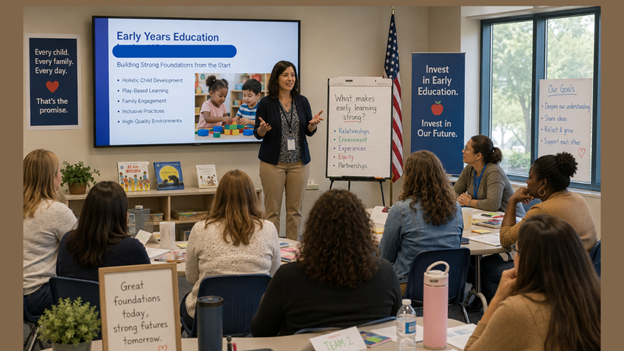
Effective communication with families is essential. Early years settings should hold regular information sessions, share evidence-based literature, and translate developmental observations into accessible language that helps parents understand the learning happening within play. When parents witness their child counting pretend money in a play shop or developing vocabulary through storytelling, scepticism often gives way to enthusiastic support.
Advocating for Policy Support and Curriculum Frameworks That Prioritise Play
Professional bodies and educators must actively engage with policymakers to ensure curriculum frameworks protect time for play. In England, the Early Years Foundation Stage (EYFS) framework explicitly recognises play as essential. Similar frameworks exist in Australia’s Early Years Learning Framework (Belonging, Being and Becoming) and New Zealand’s Te Whāriki curriculum. Educators should use these frameworks as professional tools to justify and protect play-based practice.
Training Early Years Educators in Intentional Play Based Pedagogy
Professional development must go beyond awareness to build genuine pedagogical skill. Intentional play based teaching requires educators to design rich play environments, ask open-ended questions, extend children’s thinking, and recognise learning moments as they unfold. Organisations such as Early Education UK and the National Association for the Education of Young Children (NAEYC) offer accredited training programs designed specifically for this purpose.
Using Observation and Documentation to Assess Learning Through Play
Observation-based assessment tools such as Learning Stories, developed in New Zealand, enable educators to capture rich narratives of children’s learning within play contexts. Digital platforms like Tapestry and Evidence Me allow practitioners to photograph, annotate, and share observations with families in real time. These approaches provide robust, individualised evidence of progress that aligns with holistic developmental frameworks.
Best Play Based Learning Activities for Early Years
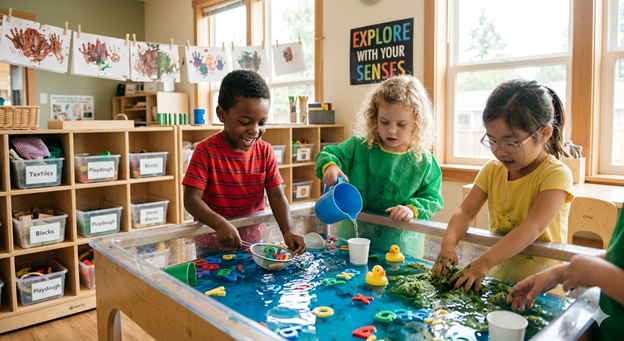
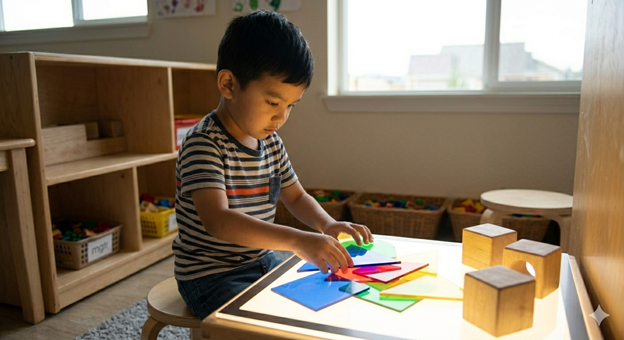
Sensory Play Activities That Stimulate Curiosity and Exploration
Sensory play engages children’s senses — touch, sight, smell, sound, and sometimes taste — to support brain development and language acquisition.
Simple activities include water and sand play, cloud dough, kinetic sand, and exploration trays filled with natural materials like leaves, bark, and shells. Research published in Early Childhood Education Journal found that sensory play significantly enhances vocabulary development and attention span in children aged two to five.
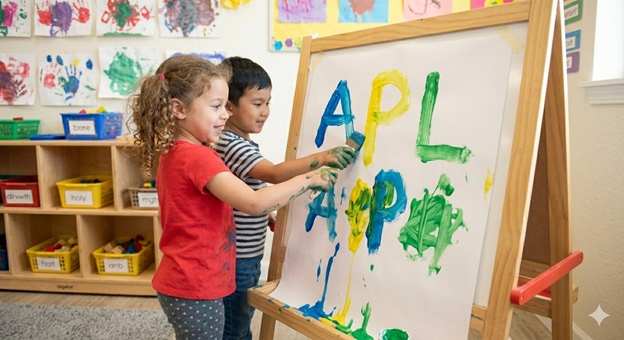
Creative Arts and Craft Activities for Imagination and Fine Motor Skills
Painting, drawing, collage-making, and clay modelling allow children to express ideas that they may not yet have words for. These activities develop fine motor control essential for writing, while simultaneously building creative thinking and self-expression. Providing open-ended materials — rather than prescriptive craft kits — empowers children to direct their own creative process, which is central to the play based philosophy.
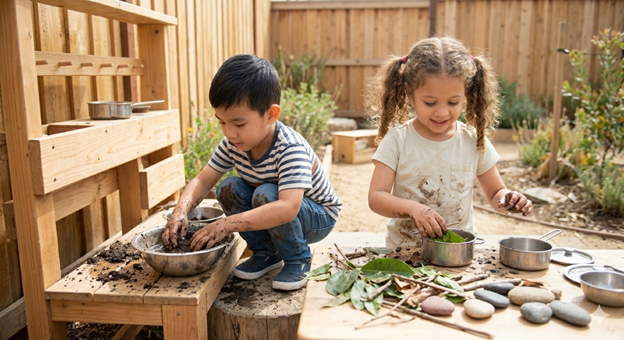
Outdoor and Nature Based Play Activities for Physical and Environmental Awareness
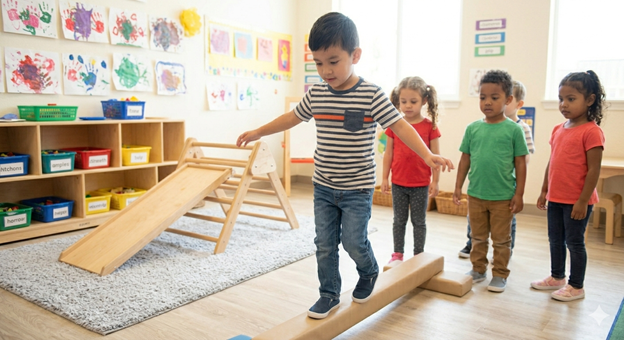
Forest schools and nature-based learning environments have gained significant traction across early years settings in Europe and beyond. Outdoor play supports gross motor development, risk assessment, and environmental stewardship. Activities such as mud kitchen play, den building, bug hunting, and planting gardens connect children to the natural world while developing scientific thinking and physical confidence.
A report by Natural England found that children who spend regular time in outdoor natural environments demonstrate improved concentration and emotional regulation.

Dramatic and Role Play Activities That Build Language and Social Skills
Role play corners set up as a post office, hospital, kitchen, or spaceship are among the most powerful contexts for language development in early years. Children naturally adopt roles, negotiate rules, and construct narratives, all of which build vocabulary, comprehension, and social understanding. Dr Stuart Brown, founder of the National Institute for Play in the US, identifies dramatic play as a critical component of healthy social and emotional development.
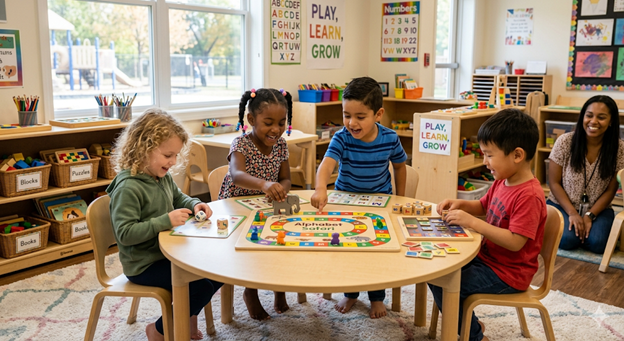
Educational Games That Support Play Based Learning
Board Games and Puzzles That Develop Problem Solving and Critical Thinking
Simple board games such as Snakes and Ladders, Orchard Toys games, and jigsaw puzzles introduce concepts of turn-taking, number recognition, sequencing, and strategic thinking in a low-pressure, enjoyable format.
Studies from the University of Chicago have shown that number-based board games significantly improve numerical understanding in preschool-aged children from lower socioeconomic backgrounds.
Cooperative Group Games That Foster Communication and Teamwork
Unlike competitive games, cooperative games require all players to work together toward a shared goal. Games such as Hoot Owl Hoot or Snug as a Bug in a Rug encourage children to communicate, listen, and make collective decisions. These experiences directly mirror the social skills children will need throughout their schooling and adult lives.
Number and Literacy Games for Early Academic Skill Development
Card games, alphabet matching games, and rhyming activities bridge the gap between play and formal skill acquisition.
Resources such as Orchard Toys’ Shopping List game support early literacy through picture and word matching, while counting games using physical objects reinforce number sense. These tools should always complement rather than replace open-ended play.
Digital and Technology Based Games Used Responsibly in Early Years Settings
When used intentionally and in moderation, technology can extend play based learning. Apps such as Toca Boca series and Endless Alphabet provide open-ended digital play environments that support language and creativity.
The key principle is that screens should supplement not substitute for physical, social, and sensory experiences. Screen time guidelines from the World Health Organisation recommend no more than one hour per day of high-quality digital content for children aged three to four.
https://meblogger.com/how-teachers-can-use-ai/
Key Strategies for Implementing Play Based Learning Successfully
Creating an Enabling Environment That Encourages Child Led Exploration
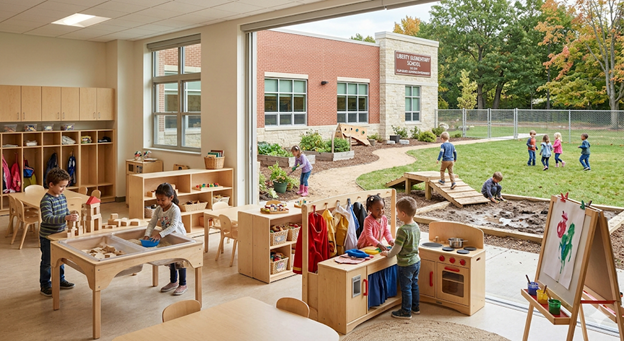
The environment is often described as the “third teacher” in early years education a concept rooted in the Reggio Emilia approach. Well-designed spaces with accessible materials, defined zones for different types of play, and connections to th e outdoors send a powerful message: your curiosity is welcome here. Practitioners should audit their environments regularly to ensure they are stimulating, inclusive, and responsive to children’s current interests.
Balancing Child Initiated Play with Guided and Structured Play Experiences
Effective play based programs include a thoughtful balance of child-initiated play where children direct their own activity and guided play, where educators join in with specific learning intentions. Research consistently shows that guided play produces the strongest outcomes when educators follow the child’s lead while subtly introducing new vocabulary, concepts, or challenges.
Embedding Learning Intentions into Everyday Play Scenarios
Skilled early years educators embed curriculum goals invisibly within play contexts. For example, a water play activity can simultaneously explore volume (mathematics), floating and sinking (science), and descriptive language (literacy). Planning should start with the child’s interest and work outward to identify the learning that emerges, rather than imposing rigid learning objectives onto play.
Building Strong Partnerships Between Educators, Parents, and the Community
Learning does not stop at the classroom door. Strong home-school partnerships ensure that children experience continuity of play-based approaches across all their environments. Sharing play ideas for home, inviting parents into the setting, and involving community members such as local gardeners, artists, or tradespeople enriches play contexts and strengthens the social fabric around each child’s learning journey.
The Long Term Impact of Play Based Learning on Child Development
How Early Play Experiences Influence School Readiness and Academic Success
A longitudinal study from High Scope Perry Preschool Project spanning over 40 years found that children who experienced high-quality play-based early education demonstrated significantly higher rates of graduation, employment, and earnings by adulthood, compared to those who did not. Play-based early years experiences build the foundational skills attention, communication, self-regulation that predict long-term academic and life success.
Building Resilience, Creativity, and Emotional Intelligence Through Play
Play is one of the few contexts in which children can experience failure safely, take risks, and learn from mistakes without real-world consequences. Building a block tower that falls teaches persistence. Losing a game teaches emotional regulation. Negotiating a disagreement in role play develops empathy. These experiences are irreplaceable in building resilient, creative, and emotionally intelligent individuals.
Research and Evidence Supporting Play Based Learning as Best Practice
The weight of global research from neuroscience, developmental psychology, and longitudinal education studies consistently supports play based learning as the most developmentally appropriate approach for young children. The Alliance for Childhood, UNICEF, and leading early childhood academics including Urie Bronfenbrenner and Lev Vygotsky have all contributed robust theoretical and empirical frameworks that position play at the center of healthy child development.
Frequently Asked Questions
1-What is the difference between free play and structured play based learning in early years?
Free play refers to child-initiated, self-directed activity with no adult agenda — children choose what to do, how to do it, and for how long. Structured play based learning, by contrast, involves an educator who designs the environment or activity with specific learning intentions in mind, while still following the child’s lead. Both are valuable. Free play builds autonomy and intrinsic motivation, while guided or structured play enables educators to scaffold children’s learning and introduce new concepts within a meaningful context. High-quality early years programs incorporate a thoughtful balance of both approaches throughout the daily routine.
2-At what age should play based learning begin for young children?
Play based learning begins from birth. Infants explore their world through sensory experiences touching textures, tracking moving objects, and responding to voices. These early interactions are foundational forms of play-based learning. As children grow through the toddler and preschool years, play becomes increasingly complex, social, and imaginative. Most early childhood education frameworks including the EYFS in England and Australia’s EYLF recommend play as the primary learning approach from birth through to approximately age eight, which broadly covers the early years and Key Stage 1 periods.
3-How can parents support play based learning at home?
Parents can support play based learning by creating simple, open-ended play environments at home. This includes offering everyday materials such as cardboard boxes, fabric scraps, natural objects, and basic art supplies rather than expensive prescriptive toys. Following the child’s interests, asking open-ended questions like “What do you think will happen if…?” and resisting the urge to over-direct or correct play are all powerful strategies. Reading together, storytelling, cooking, and gardening are also rich play-based learning experiences. Most importantly, parents should give children uninterrupted time to play freely without screens or structured adult-led activities.
4-Is play based learning effective for children with special educational needs?
Yes, play based learning is widely recognised as highly effective for children with special educational needs and disabilities (SEND). Play provides a flexible, low-pressure context in which children can engage at their own pace and developmental level. For children with autism spectrum conditions, sensory play and structured role play can support communication and social skills development. For children with developmental delays, play-based activities can be carefully differentiated by skilled practitioners to meet individual needs. The British Journal of Special Education has published multiple studies affirming that play-based approaches, when delivered by trained practitioners, produce positive outcomes for children with a wide range of additional needs.
5-How do early years educators assess and track development through play based learning?
Early years educators use observation-based assessment to track children’s development within play. This typically involves regular observations both planned and spontaneous which are documented through photographs, written notes, and video recordings. These observations are then analysed against developmental milestones and curriculum framework goals. Tools such as Learning Stories (originating from New Zealand’s Te Whāriki curriculum) provide narrative assessments that capture the learning process rather than just outcomes. Digital platforms such as Tapestry, Evidence Me, and SeeSaw enable real-time documentation and family sharing. Assessments are used to inform future planning, identify emerging needs, and celebrate children’s achievements holistically.
Conclusion:
Embracing Play as the Foundation of Early Years Education
Summarising the Core Benefits of Play Based Learning
Play based learning in early years is not simply a pedagogical preference — it is a developmental necessity. From brain development and academic readiness to social competence and emotional resilience, the evidence is clear and compelling. Play gives children the time, space, and freedom to become confident, curious, capable learners.
Encouraging Educators and Parents to Champion Play in Early Childhood
Every educator, parent, and policymaker has a role to play in protecting and championing play-based approaches. When we trust children to lead their own learning within thoughtfully designed environments, we invest in their long-term wellbeing and success. The question is not whether children should play the question is how we can ensure that every child has the opportunity to do so.