
Discover proven strategies to manage challenging behaviour in early years settings. Practical EYFS guidance for experts, nursery staff, and parents.
Introduction
Understanding how to manage challenging behaviour in early years settings is one of the most important skills any practitioner or parent can develop. In this guide, you’ll find a clear breakdown of what challenging behaviour looks like, why it happens, and most importantly ten evidence backed strategies to help you respond with confidence and compassion.
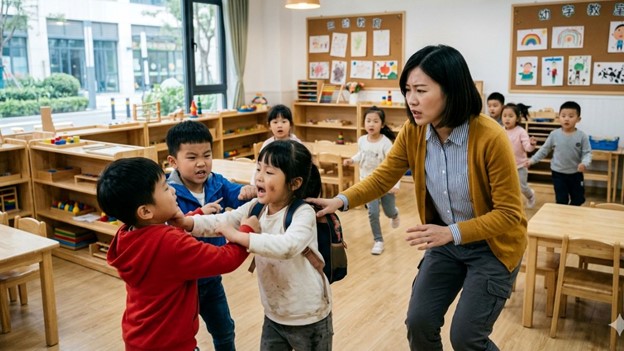
Ask any nursery expert about the most demanding part of their role and you’ll likely hear the same answer: navigating challenging behaviour. From daily collapses at tidy-up time to biting incidents that leave everyone shaken, managing behaviour in early years settings can feel determined, emotionally draining, and without the right tools deeply frustrating.
But here’s what years of research and practice have confirmed: behaviour is communication. When a two-year-old throws a chair or a four-year-old refuses to leave the sandpit for the third time, they are not being deliberately difficult. They are telling you something about how they feel, what they need, and what they cannot yet put into words.
How to Manage Challenging Behaviour in Early Years Settings
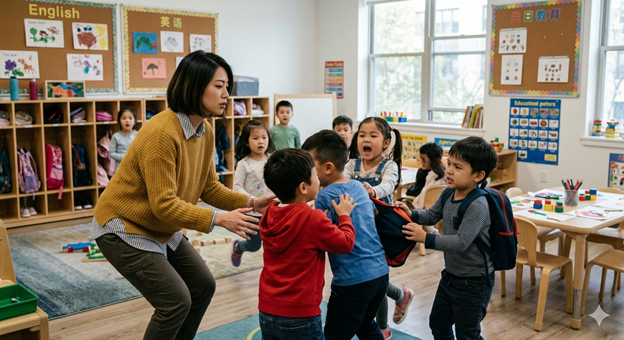
Managing challenging behaviour in early years settings involves understanding the root cause before responding. Build constant routines, strong relationships, and use positive reinforcement. Teach emotional literacy, reduce triggers, and work in partnership with parents. Behaviour is always communication respond with curiosity, not just consequence.
What Is Challenging Behaviour in Early Years?
Challenging behaviour in early years refers to any behaviour that is persistent, intense, or frequent enough to interfere with a child’s learning, wellbeing, or their relationships with others.
It’s important to note that what counts as “challenging” varies with age. Some behaviours are entirely developmentally appropriate toddlers bite, preschoolers have tantrums, and children under five often struggle to share, wait, or follow multi-step instructions. The concern arises when these behaviours persist beyond the expected developmental window, increase in harshness, or significantly disturb the child or those around them.
Common examples include:
- Hitting, kicking, biting, or scratching other children or adults
- Frequent and intense tantrums lasting well beyond what’s typical
- Insistent refusal to follow adult instructions or routines
- Aggressive or destructive behaviour towards resources or property
- Withdrawal, self-harm, or repeated distress
- Extreme difficulty with transitions between activities
- Persistent disturbance that prevents the group from learning
None of these behaviours exist in isolation. Each one carries a message and our job as practitioners is to interpret it.
7 Reasons Why Do Children Display Challenging Behaviour?
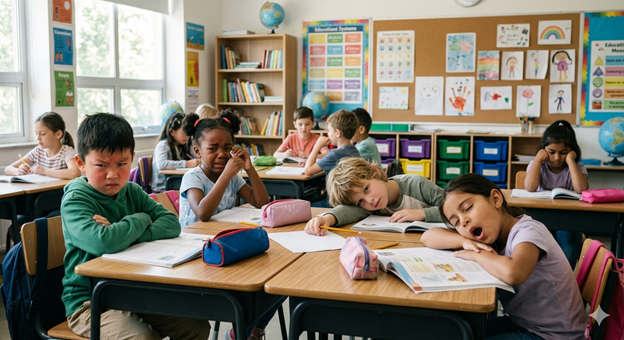
Before we can support a child, we need to understand what’s driving the behaviour. Children rarely act out for the sake of it. Below are the most common primary causes:
1-Communication Difficulties
Children under five are still developing language. When a child cannot articulate “I’m frustrated,” “I’m scared,” or “I don’t understand what you want,” their body often does the talking instead. A child who bites might simply not have the words to express “that’s mine” or “stop.”
2-Emotional Regulation Challenges
The part of the brain responsible for managing emotions the prefrontal cortex isn’t fully developed until a person’s mid-twenties. Expecting young children to regulate strong feelings without support is like expecting them to run before they can walk.
3-Changes in Routine
Young children feel safe through predictability. A new baby at home, a change in key person at nursery, or even a different lunchtime arrangement can be enough to destabilise a child’s sense of security and trigger a behavioural response.
4-Tiredness and Hunger
A tired or hungry child is a dysregulated child. Late nights, early starts, skipped breakfasts, or missed snacks have an immediate and significant impact on behaviour. Before assuming a behaviour problem, always consider the basics.
5-Sensory Needs
Some children are hypersensitive or hyposensitive to sensory input noise, touch, light, smell, or texture. A noisy lunchtime or a scratchy jumper can send a child into sensory overload, and challenging behaviour is often the result. https://meblogger.com/play-based-learning-in-early-years/
6-Seeking Connection and Attention
Children are wired for connection. A child who hasn’t had quality one-to-one time, who is feeling insecure, or who is navigating a difficult home environment may use behaviour even negative behaviour to seek the attention they need.
7-Additional Learning or Developmental Needs
Some children display challenging behaviour because they are experiencing developmental delays, autism range conditions, ADHD, or other additional needs that have not yet been identified or supported. This is not the child’s fault it is a signal that they need more tailored help.
The Importance of Understanding the Cause Before Responding
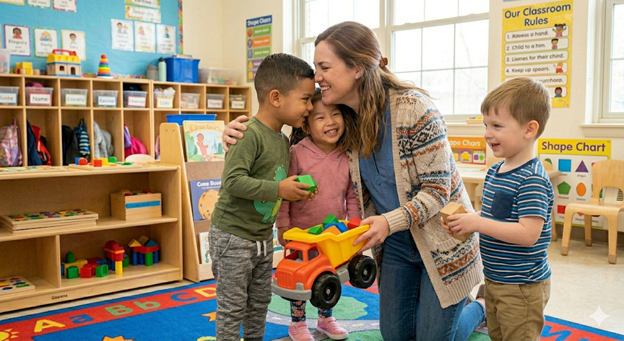
There is a fundamental difference between reacting to behaviour and understanding behaviour.
A reactive approach raising your voice, issuing a punishment, or removing a child from a situation without explanation might stop the behaviour in that moment. But it doesn’t address the cause, which means the behaviour is almost certain to return.
An understanding-based approach asks: what is this child trying to tell me? It treats the behaviour as a signal rather than a failing. And it responds in a way that addresses the root cause which is far more likely to lead to lasting change.
This shift in perspective takes practice, especially in the heat of the moment. But it is the single most important reframe any practitioner or parent can make.

10 Effective Strategies for Managing Challenging Behaviour in Early Years Settings
1. Build Strong Positive Relationships
Why it works: Children are far more likely to cooperate with adults they trust, feel safe with, and genuinely like. The quality of the relationship between a child and their key person is one of the strongest predictors of positive behaviour.
How to implement it:
- Spend regular one-to-one time with each child in your key group
- Follow the child’s lead in play — let them choose the activity
- Use the child’s name warmly and frequently
- Show genuine interest in their lives, families, and interests
Real-life example: Jayden, aged three, was regularly refusing to come inside from the garden and becoming aggressive when adults tried to guide him. His key person began spending ten minutes each morning playing alongside him outdoors before any transitions were needed. Within two weeks, Jayden’s resistance at transition times reduced significantly — because he now trusted his key person.
2. Establish Consistent Routines
Why it works: Predictable routines reduce anxiety. When children know what comes next, they feel safe — and a safe child is a more regulated child.
How to implement it:
- Use a visual timetable with pictures to show the daily routine
- Give transition warnings: “In five minutes, we’re going to tidy up”
- Keep the sequence of the day consistent, even on days with special activities
- Prepare children for any changes to routine in advance, where possible
Real-life example: Mia, aged four, had daily meltdowns at lunchtime. Her key worker introduced a visual routine strip showing each step from activity time to sitting down to eat. Mia began carrying her strip around, preparing herself for each transition. The breakdowns reduced within a fortnight.
3. Set Clear and Age-Appropriate Expectations
Why it works: Children cannot meet expectations they don’t understand. Clear, consistent, and developmentally realistic boundaries give children the framework they need.
How to implement it:
- Keep rules simple, positive, and few “We use kind hands” rather than “Don’t hit”
- Explain the reason behind the rule in terms children understand
- Reinforce expectations regularly, not just when they’re broken
- Make sure all staff communicate the same expectations consistently
Real-life example: A room team struggling with running in the corridor switched from shouting “Don’t run!” to calmly prompting “walking feet, please” every time. Consistent use across the whole team meant children began self-correcting each other within days.
4. Use Positive Reinforcement Effectively
Why it works: Children repeat behaviours that earn positive responses. Catching children being good and making a point of noticing it is one of the most powerful tools in behaviour support for preschool children.
How to implement it:
- Offer specific, genuine praise: “I love how you waited so patiently for your turn”
- Use non-verbal affirmation a smile, a thumbs up, a wink
- Avoid empty or repetitive praise (“good boy!”) which loses impact quickly
- Consider a simple sticker chart or reward system for children who benefit from visual reinforcement
Real-life example: Tom, aged three and a half, was frequently aggressive during group activities. His key person began actively looking for moments of positive behaviour sitting nicely, sharing and naming them immediately. Tom began seeking out those moments deliberately.
5. Teach Emotional Literacy
Why it works: Children who can name their emotions are better equipped to manage them. Emotional literacy is a learnable skill, and early years settings are ideally placed to teach it.
How to implement it:
- Use picture books and puppets to explore feelings (e.g., The Colour Monster by Anna Llenas)
- Create a “feelings board” where children can show how they feel each morning
- Name emotions as they arise: “I can see you’re really frustrated right now”
- Model your own feelings: “I’m feeling a little tired today, so I’m taking some deep breaths”
Real-life example: A preschool room introduced a daily feelings check-in using coloured emotion cards. Within six weeks, children were using the vocabulary spontaneously “I’m feeling wobbly today, Miss” which transformed staff’s ability to support them proactively.
6. Model Calm Behaviour
Why it works: Children co-regulate with the adults around them. If the adult is anxious, loud, or reactive, the child’s nervous system will respond in kind. A calm adult is a child’s most powerful regulator.
How to implement it:
- Lower your voice when a situation escalates don’t raise it
- Use slow, deliberate movements during difficult moments
- Practise and model breathing techniques with the whole group regularly
- Be aware of your own stress responses and seek support when needed
Real-life example: During a child’s extended meltdown, a practitioner sat quietly on the floor nearby, breathing slowly, and narrating softly: “I’m here. You’re safe. Take your time.” The child’s own breathing gradually slowed and matched the adult’s within four minutes.
7. Identify and Reduce Behaviour Triggers
Why it works: Many challenging behaviours are predictable if you look closely. Identifying patterns times of day, specific activities, sensory environments allows you to be proactive rather than reactive.
How to implement it:
- Keep an ABC (Antecedent-Behaviour-Consequence) diary for persistent concerns
- Look for patterns: Is the behaviour worse before lunch? After a particular activity? During transitions?
- Make small environmental adjustments — reducing noise, providing fidget tools, creating calm spaces
- Share observations across the team so everyone can contribute to the picture
Real-life example: Staff noticed that Leo, aged four, was consistently dysregulated after music sessions. Observation revealed the volume in the music room was triggering sensory overload. Providing ear defenders and a quieter spot transformed his post-music behaviour almost immediately.
8. Offer Choices and Encourage Independence
Why it works: Many challenging behaviours particularly refusal and defiance are driven by a need for control. Offering genuine choices gives children a sense of agency within appropriate boundaries.
How to implement it:
- Offer two options rather than open-ended questions: “Would you like to tidy the bricks or the books first?”
- Avoid situations where the only answer is “no” reframe the question
- Celebrate children’s independent decisions and problem-solving
- Give children age-appropriate responsibilities in the setting
Real-life example: Freya refused to come to the carpet every day. Instead of insisting, her key worker started asking, “Would you like to sit near me or near the window today?” Freya always chose and always came. The transition became conflict-free.
9. Create a Supportive Learning Environment
Why it works: The physical environment directly affects behaviour. A cluttered, overstimulating, or chaotic space increases anxiety and dysregulation. A calm, well-organised space supports emotional regulation and self-direction.
How to implement it:
- Create a calm corner or quiet space where children can self-regulate
- Reduce visual clutter and ensure resources are clearly labelled and accessible
- Ensure outdoor time is available daily physical activity is a significant regulator
- Consider sensory resources: sand, water, play dough, and similar materials have a naturally calming effect
Real-life example: One nursery struggled with daily chaos during free play. After introducing a designated calm corner with books, weighted blankets, and soft lighting, children began independently choosing to visit it when they felt overwhelmed significantly reducing growths.
10. Work Closely with Parents and Carers
Why it works: Children are most supported when home and nursery are working as a consistent, communicating team. Parents hold vital information about what’s happening at home; practitioners hold insight into what’s happening at nursery. Together, the picture is complete.
How to implement it:
- Share observations regularly and positively not just when there’s a concern
- Hold supportive, private conversations about behaviour, never in front of other parents or the child
- Develop consistent strategies that work both at home and in the setting
- Invite parents into the problem-solving process rather than presenting them with a verdict
Real-life example: A child was having daily separation anxiety-related meltdowns. When the key person spoke with parents, they learned that mornings at home had become very rushed following a new sibling. Together, they developed a simple handover routine that both home and nursery followed and the meltdowns reduced within a week.
Common Behaviour Management Mistakes to Avoid
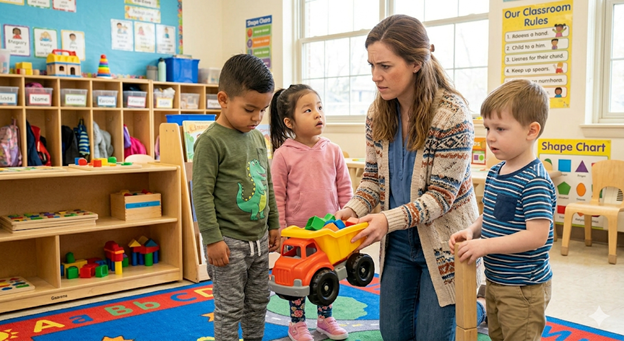
Even the most experienced practitioners can fall into patterns that inadvertently make behaviour worse. Here are the most common pitfalls:
Inconsistency.
If the rule is different depending on the adult, the day, or the child’s mood, children lose trust in the boundaries. Consistency across the whole team is non-negotiable.
Excessive punishment.
Repeated permissions, time-outs, or removal from activities particularly without explanation damage the child-adult relationship and rarely address the cause. They teach children what not to do, but not what to do instead.
Public criticism.
Addressing behaviour in front of peers is humiliating for a young child and almost always escalates the situation. Deal with behaviour calmly and privately wherever possible.
Unrealistic expectations.
Expecting a two-year-old to share gracefully, sit still for twenty minutes, or manage transitions without support is setting both the child and the adult up to fail. Know your developmental milestones.
Ignoring primary causes.
Surface level behaviour management without curiosity about the cause will produce limited, short-term results. Always ask “why” before deciding “what next.”
Supporting Children with Additional Needs
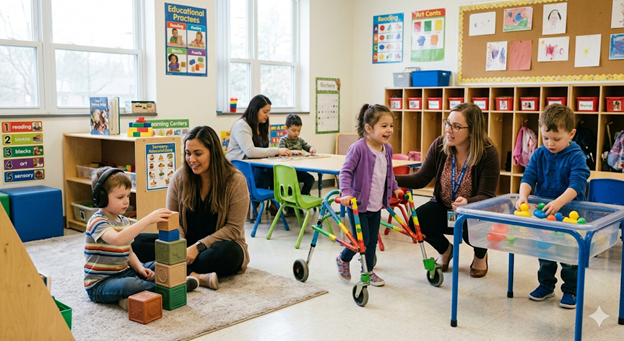
For some children, challenging behaviour is directly linked to a special educational need or disability (SEND). This includes autism spectrum conditions, attention deficit hyperactivity disorder (ADHD), speech, language, and communication needs (SLCN), sensory processing difficulties, and developmental delays.
These children are not choosing to be difficult. Their behaviour is frequently a response to a world that doesn’t yet feel safe, predictable, or adapted to their needs.
Individualised support is essential. A generic behaviour management approach will rarely be effective for a child with SEND. Effective support includes:
- Working with the SENCO to develop an individual support plan
- Making environmental adjustments to reduce sensory overwhelm
- Using visual supports, social stories, and Makaton where appropriate
- Bridging with speech and language therapists, educational psychologists, or other specialists
- Ensuring all staff understand the child’s specific profile of needs
Early identification and targeted support make a significant difference to both short and long-term outcomes. If you have concerns, act early.
When Should Early Years Practitioners Seek Additional Support?
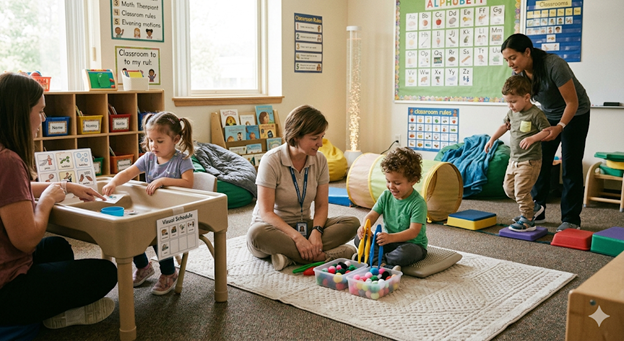
Sometimes, despite best efforts, a child’s behaviour requires specialist input. Consider seeking additional support when:
- The behaviour is putting the child or others at risk of harm
- Strategies tried consistently over a sustained period are not making a difference
- The behaviour appears to be significantly affecting the child’s emotional wellbeing or development
- Staff are finding the behaviour difficult to manage safely
- There is a suspicion of an underlying developmental or additional need
In these situations, practitioners should:
- Discuss concerns with the setting’s SENCO
- Seek guidance from the local authority’s early years inclusion team
- Initiate a referral to relevant specialists (speech and language therapy, occupational therapy, educational psychology)
- Involve parents throughout, ensuring they feel supported rather than blamed
- Document observations carefully to support any referral process
Seeking help is not a sign of failure. It is a sign of commitment to the child.
Frequently Asked Questions
What causes challenging behaviour in young children?
Challenging behaviour in young children is usually caused by an unmet need. Common causes include communication difficulties, emotional dysregulation, hunger or tiredness, changes in routine, sensory sensitivities, a need for connection and attention, or an unidentified additional need such as autism or ADHD. Behaviour is always communication.
How should practitioners respond to aggressive behaviour in the early years?
Respond calmly and without escalating the situation. Ensure all children are safe first. Then acknowledge the feeling behind the behaviour (“I can see you’re really angry”) before addressing the action. Avoid shouting, public reprimands, or immediate punishment. Once the child is calm, talk about what happened and what could be done differently next time.
What are positive behaviour strategies in EYFS?
Positive behaviour strategies in EYFS include building strong key-person relationships, establishing predictable routines, using visual timetables, offering genuine choices, praising specific positive behaviours, teaching emotional literacy, co-regulating with a calm adult presence, and identifying and reducing triggers. The emphasis is always on teaching children what to do, not just what not to do.
How can emotional regulation be taught to preschool children?
Emotional regulation is developed through repeated, safe experiences with a regulated adult. Practitioners can support it by naming emotions as they arise, teaching simple calming strategies like deep breathing, creating calm spaces in the setting, using books and puppets to explore feelings, and consistently co-regulating with children rather than expecting them to manage alone.
When should parents be concerned about challenging behaviour?
Parents should seek advice if challenging behaviour is very frequent, intense, or prolonged for the child’s age; if it is significantly affecting their child’s wellbeing, relationships, or learning; or if it is accompanied by other developmental concerns such as speech delays or difficulties with social interaction. Speak to your child’s key person, health visitor, or GP as a first step.
What is the difference between positive behaviour support and punishment?
Positive behaviour support focuses on understanding the function of the behaviour and teaching alternative, more appropriate ways to meet the same need. Punishment focuses on reducing the behaviour through negative consequences. Research consistently shows that positive behaviour support produces better long-term outcomes, particularly for young children and those with additional needs.
How does the EYFS framework address behaviour management?
The EYFS (Early Years Foundation Stage) framework places personal, social, and emotional development (PSED) as a prime area of learning and development. It expects settings to support children’s self-confidence, self-awareness, and management of feelings and behaviour. Behaviour management approaches must be consistent with the welfare requirements of the EYFS, which explicitly prohibit the use of physical intervention, humiliation, or any form of corporal punishment.
Conclusion
Learning how to manage challenging behaviour in early years settings is not about having a perfect toolkit or never feeling out of your depth. It’s about shifting perspective — from seeing behaviour as a problem to be controlled, to seeing it as communication to be understood.
When we approach a child’s behaviour with curiosity rather than frustration, we ask better questions. When we build relationships, establish routines, teach emotional literacy, and work alongside families, we create the conditions for children to genuinely thrive.
No two children are the same, and no single strategy works for every situation. But the principles remain consistent: stay curious, stay calm, and stay connected.
Whether you’re a nursery practitioner, a childminder, a preschool teacher, or a parent doing your very best — you are not alone in finding this challenging. And you are not without support. Use this guide, lean on your colleagues, involve your families, and seek specialist help when you need it.
The children in your care are lucky to have someone who cares enough to keep learning.