
How to Homeschool Kids Ages 3–8: A Simple Guide for Parents
Discover how to homeschool kids ages 3–8. Get age-by-age lessons, routines, activities, and low-cost tips for busy parents.
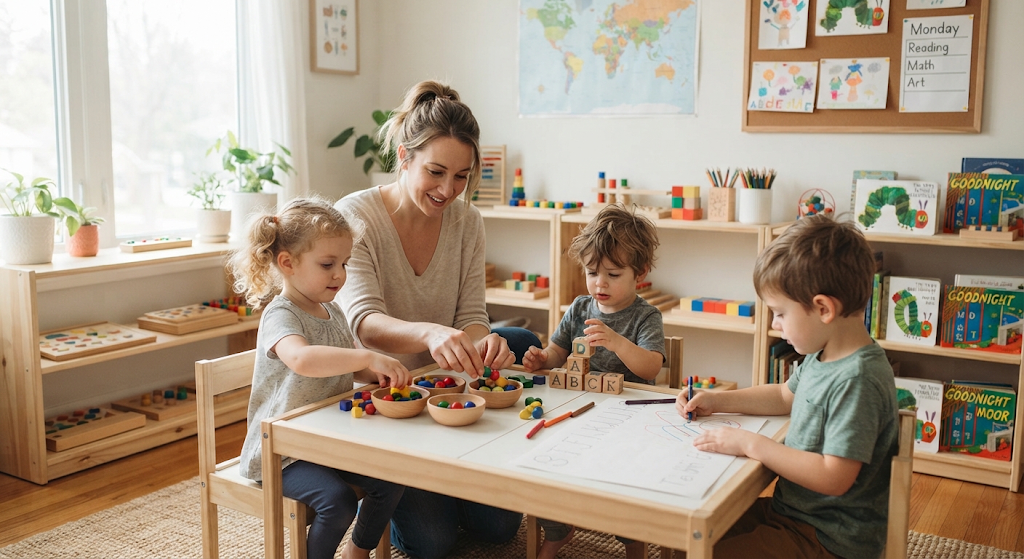
If you are wondering how to homeschool kids ages 3-8, here is the good news: you do not need to turn your living room into a classroom. Young children learn best through play, conversation, and everyday activities not worksheets and long lessons.
This guide walks you through everything you need to start homeschooling with confidence. You will learn what to teach at each age, how to build a simple daily routine, how many hours you actually need, and dozens of practical activities you can start using today even on a tight budget.
Whether you are homeschooling a curious 3-year-old or an independent 8-year-old, this guide gives you a clear, realistic plan.
What Is Homeschooling for Young Children?
Homeschooling simply means your child learns at home, guided by you, instead of attending a traditional school.
For children ages 3–8, homeschooling looks very different from a classroom. There are no rows of desks, no bells, and no long lectures. Instead, learning happens through:
- Conversation and storytelling
- Hands-on activities
- Play and exploration
- Simple, short lessons
- Everyday routines like cooking or shopping
The biggest difference between homeschooling and traditional schooling at this age is flexibility. You can teach a concept while baking cookies, on a walk, or during bath time. Learning does not have to happen at a desk to count.
Many parents also blend approaches using a curriculum for some subjects and a more relaxed, play-based style for others. There is no single “correct” way to homeschool young children.
Is Homeschooling Suitable for Ages 3–8?
Yes. In fact, ages 3–8 are ideal for a flexible, play-based homeschool approach, because this is exactly how young children learn best.
At this stage, children build foundational skills through:
- Play – builds problem-solving, creativity, and social skills
- Movement – supports brain development and physical coordination
- Conversation – builds vocabulary and communication skills
- Exploration – encourages curiosity and independent thinking
- Hands-on activities – strengthen understanding better than passive listening
Young children have short attention spans. A 3-year-old may focus for only a few minutes on one task, while an 8-year-old can usually manage longer, more structured activities. This is completely normal and expected.
Key takeaway: Homeschooling ages 3–8 should feel more like guided everyday learning than formal schooling.
How to Start Homeschooling: A Step-by-Step Plan
If you are asking how do I start homeschooling my child, follow these seven steps.
- Understand your child’s current level. Notice what they already know letters, numbers, colors, and what they enjoy.
- Set simple learning goals. Keep goals small and realistic, such as “recognize 10 letters this month.”
- Choose core subjects. For young children, this usually means reading, writing, math, and general knowledge through science and social studies.
- Select resources. These can be library books, printables, educational apps, or a structured curriculum whatever fits your budget and teaching style.
- Create a flexible routine. Build a loose daily rhythm rather than a strict timetable.
- Start small. Begin with short sessions and add more only when your child is ready.
- Observe and adjust. Pay attention to what works and change your plan as needed. Homeschooling is not fixed it evolves with your child.
This step-by-step approach works whether you are starting with a 3-year-old or jumping in mid-year with a 7-year-old.
What to Teach at Each Age: 3 to 8
Every child develops at their own pace, so treat these as general guidelines, not strict rules.
| Age | Main Learning Goals | Skills to Develop | Example Activities |
|---|---|---|---|
| 3 years | Language growth, early number sense, sensory exploration | Vocabulary, listening, fine motor skills, following simple instructions | Story time, sorting shapes, playdough, simple puzzles |
| 4 years | Letter and number recognition, early literacy | Pre-writing skills, counting to 10–20, social skills | Tracing letters, counting games, pretend play, nature walks |
| 5 years | Beginning reading, basic math concepts | Phonics awareness, number operations, cooperation | Rhyming games, simple addition with objects, drawing stories |
| 6 years | Reading simple words/sentences, basic writing | Sentence formation, place value, curiosity about the world | Reading aloud together, journaling, simple science experiments |
| 7 years | Reading fluency, structured writing, math facts | Spelling patterns, problem-solving, independent tasks | Writing short stories, math word problems, nature journals |
| 8 years | Independent reading, paragraph writing, multi-step math | Research skills, critical thinking, responsibility | Book reports, simple research projects, measuring and cooking |
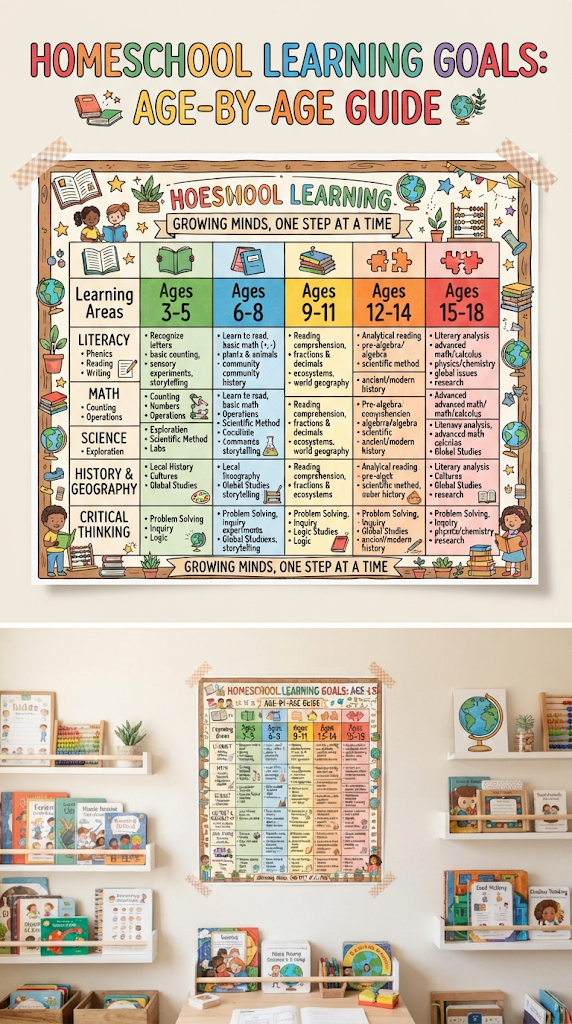
Core Subjects to Include in a Homeschool Curriculum
A homeschool curriculum for ages 3-8 does not need to be complicated. Focus on what children genuinely need at this stage.
- Reading and phonics – Children need exposure to letter sounds, sight words, and lots of read-aloud time. This matters more than memorizing rules. Read More
- Writing – Start with fine motor practice (drawing, tracing), then move to letters, words, and simple sentences.
- Mathematics – Focus on number sense first: counting, comparing, and understanding quantities before moving to written equations.
- Science – Young children learn science through curiosity asking “why” and exploring nature, not memorizing facts.
- Social studies – Simple concepts like family, community helpers, maps, and cultures introduced through stories and conversation.
- Art and creativity – Drawing, coloring, and crafts build fine motor skills and self-expression.
- Physical activity – Movement supports brain development and should be part of every homeschool day. Read More
- Life skills – Tasks like tidying up, helping in the kitchen, and dressing independently build real-world competence.
- Social-emotional learning – Recognizing feelings, sharing, and taking turns are just as important as academics at this age. Read More
The goal is not to check off subjects. The goal is to help your child build real skills they can use.
How Many Hours a Day Should Young Children Homeschool?
Short answer: Most children ages 3–8 need far less structured “seat time” than people assume.
| Age | Suggested Focused Learning Time |
|---|---|
| 3–4 years | 15–30 minutes total (in short bursts) |
| 5–6 years | 30–60 minutes total |
| 7–8 years | 1–2 hours total |
These numbers cover focused, adult-guided activities. They do not include the many hours of natural learning that happen throughout the day.
Learning time is not the same as sitting at a desk. Children learn while:
- Cooking – measuring, counting, following steps
- Reading stories – vocabulary, listening skills, imagination
- Outdoor walks – observing nature, asking questions
- Shopping – counting money, reading labels, comparing sizes
- Building – with blocks or recycled materials, learning shapes and balance
- Drawing – fine motor skills and creative expression
- Household activities – responsibility and practical life skills
- Conversations – vocabulary and reasoning
- Games – problem-solving and turn-taking
There is no universal rule here. Some days will include more structured learning, other days will be almost entirely play-based and that is perfectly fine for this age group.
Sample Homeschool Daily Routines
These are flexible starting points, not fixed timetables. Adjust them to match your family’s rhythm.
Sample Routine: Ages 3–4
| Time | Activity |
|---|---|
| Morning | Breakfast, free play |
| Mid-morning | Story time + one short activity (letters, colors, shapes) |
| Late morning | Outdoor play or movement |
| Afternoon | Lunch, quiet time or nap |
| Afternoon | Sensory play, art, or pretend play |
| Evening | Family time, bedtime story |
Sample Routine: Ages 5–6
| Time | Activity |
|---|---|
| Morning | Breakfast, short reading/phonics activity |
| Mid-morning | Math activity (hands-on) |
| Late morning | Outdoor play or nature walk |
| Afternoon | Lunch, quiet reading time |
| Afternoon | Art, science exploration, or life skills task |
| Evening | Family time, bedtime story |
Sample Routine: Ages 7–8
| Time | Activity |
|---|---|
| Morning | Breakfast, reading practice |
| Mid-morning | Writing or journaling |
| Mid-morning | Math lesson and practice |
| Midday | Outdoor play or exercise |
| Afternoon | Lunch, independent reading |
| Afternoon | Science or social studies project |
| Late afternoon | Free time, hobbies, or life skills |
| Evening | Family time, reading together |
25 Practical Homeschool Activities for Ages 3–8
Each activity uses simple materials you likely already have at home.
- Letter hunt — Need: magazines, scissors. Do: find and cut out letters of the alphabet. Learns: letter recognition.
- Story retelling — Need: a picture book. Do: read together, then ask your child to retell it in their own words. Learns: comprehension, sequencing.
- Sight word bingo — Need: paper, marker. Do: make a simple bingo grid with sight words. Learns: reading fluency.
- Rhyming game — Need: none. Do: take turns saying rhyming words. Learns: phonemic awareness.
- Alphabet scavenger hunt — Need: index cards with letters. Do: hide them around the house to find. Learns: letter recognition, movement.
- Vocabulary jar — Need: jar, slips of paper. Do: add a new word each week and use it in sentences. Learns: vocabulary building.
- Journaling — Need: notebook. Do: write or draw about the day. Learns: writing skills, self-expression.
- Letter tracing in sand or rice — Need: a tray, sand or rice. Do: trace letters with a finger. Learns: pre-writing skills.
- Grocery list writing — Need: paper, pencil. Do: have your child help write or copy the list. Learns: writing, vocabulary.
- Counting collections — Need: buttons, coins, or blocks. Do: count and group objects. Learns: number sense.
- Shape hunt around the house — Need: none. Do: find objects matching different shapes. Learns: geometry basics.
- Baking measurement practice — Need: measuring cups, simple recipe. Do: measure ingredients together. Learns: math, following steps.
- Number line hopscotch — Need: chalk or tape. Do: draw numbers to hop across. Learns: number order, movement.
- Simple addition with snacks — Need: crackers or fruit. Do: combine small groups and count the total. Learns: addition concepts.
- Nature walk observation — Need: none. Do: walk outside and notice plants, insects, weather. Learns: science observation skills.
- Kitchen science: sink or float — Need: a bowl of water, small objects. Do: predict and test which items float. Learns: scientific thinking.
- Growing a plant — Need: seeds, cup, soil. Do: plant and observe growth over weeks. Learns: life cycles, patience.
- Family tree drawing — Need: paper, crayons. Do: draw and label family members. Learns: social studies, vocabulary.
- Map treasure hunt — Need: simple hand-drawn map. Do: follow the map to find a hidden item. Learns: spatial awareness.
- Free drawing time — Need: paper, crayons. Do: let your child draw anything they choose. Learns: creativity, fine motor skills.
- Recycled material building — Need: boxes, tubes, tape. Do: build a structure together. Learns: problem-solving, creativity.
- Obstacle course — Need: pillows, chairs, tape. Do: set up a simple course to crawl, jump, and balance through. Learns: gross motor skills.
- Simple puzzle building — Need: age-appropriate puzzle. Do: work on it together. Learns: problem-solving, patience.
- Helping with laundry sorting — Need: laundry basket. Do: sort clothes by color or type. Learns: categorizing, life skills.
- Setting the table — Need: plates, cutlery. Do: have your child set the table independently. Learns: life skills, responsibility.
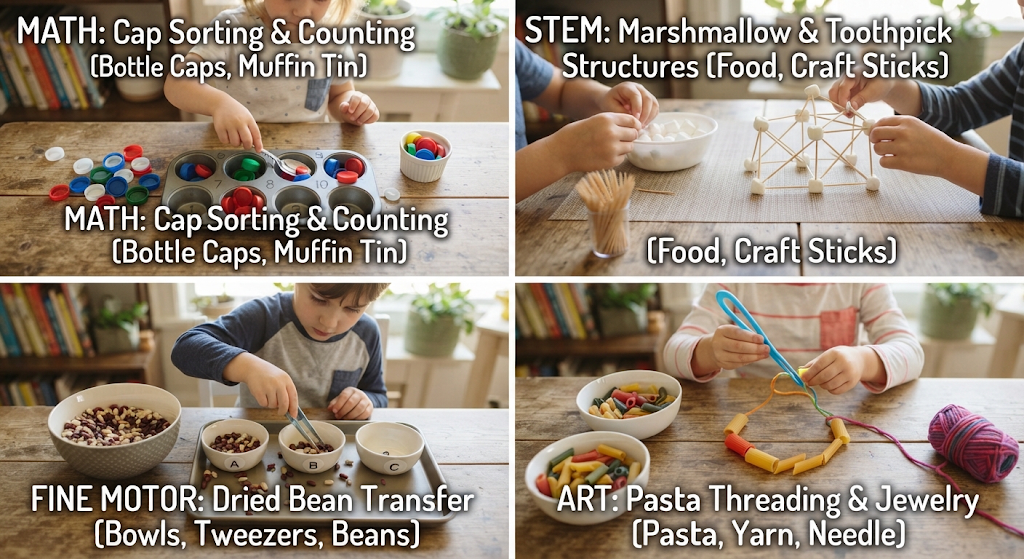
How to Homeschool Without an Expensive Curriculum
You do not need a costly curriculum to homeschool well. Many effective resources are free or very low-cost.
- Library books – Free access to reading material across every subject and reading level.
- Household objects – Buttons, spoons, and containers work well for counting and sorting.
- Nature – Backyards, parks, and even sidewalks offer endless science and observation opportunities.
- Recycled materials – Boxes and containers are perfect for building and craft activities.
- Printable resources – Many educational websites offer free worksheets and activity sheets.
- Educational games – Board games and card games teach math, vocabulary, and strategy.
- Everyday experiences – Cooking, shopping, and chores are naturally rich learning opportunities.
A helpful mindset: instead of asking “what curriculum do I need to buy,” ask “what is already around me that I can turn into a lesson?”
How to Create a Simple Weekly Homeschool Plan
30 Lesson Plan Ideas for Kindergarten| Free & Ready to Use
Use this reusable template to plan your week. Fill it in loosely it is meant to guide you, not restrict you.
| Day | Learning Goal | Activity | Materials | Independent Practice | Outdoor/Play | Reading | Review |
|---|---|---|---|---|---|---|---|
| Monday | e.g., recognize letter B | Letter hunt | Magazines, scissors | Trace letter B | Backyard play | Story time | — |
| Tuesday | e.g., count to 10 | Counting collections | Buttons | Number worksheet | Walk outside | Read aloud | — |
| Wednesday | e.g., shapes | Shape hunt | None | Draw shapes | Park visit | Story time | — |
| Thursday | e.g., science observation | Nature walk | None | Draw what was seen | Free play | Read aloud | — |
| Friday | Review the week | Favorite activity repeat | Varies | Optional | Family outing | Story time | Quick chat about what was learned |
Feel free to copy this table into a notebook or spreadsheet and adjust the goals each week based on your child’s progress.
How to Make Homeschooling Fun and Engaging
- Follow your child’s interests. If they love dinosaurs, use dinosaurs to teach counting, reading, and writing.
- Use games. Turn practice into a game whenever possible.
- Add movement. Let children jump, hop, or act things out while learning.
- Use stories. Stories make abstract ideas easier to understand.
- Give choices. Let your child pick between two activities to build ownership.
- Use hands-on materials. Touching and manipulating objects helps concepts stick.
- Connect learning to real life. Cooking, shopping, and chores are natural lessons.
- Keep lessons short. Short, focused bursts work better than long sessions.
- Celebrate effort. Praise the process, not just the correct answer.
How to Know if Your Child Is Making Progress
You do not need formal tests to track progress in the early years. Instead, try:
- Observation – Notice new skills your child shows during play or daily tasks.
- Conversation – Ask questions and listen to how they explain ideas.
- Reading aloud – Listen for improved fluency and comprehension over time.
- Work samples – Keep a folder of drawings, writing, and worksheets to compare over months.
- Simple checklists – Track skills like “can count to 20” or “recognizes all letters.”
- Projects – A finished project shows what a child can apply, not just recall.
- Practical demonstrations – Can they follow a recipe, tell time, or explain a science observation?
Remember that children develop at different rates. If you have significant concerns about your child’s development or learning, it is a good idea to speak with a pediatrician, teacher, or learning specialist.
Common Homeschooling Mistakes Parents Should Avoid
- Trying to copy traditional school. Long desk sessions rarely work for young children.
- Expecting long attention spans. A 4-year-old cannot sit still for an hour, and that is normal.
- Doing too many worksheets. Hands-on learning is usually more effective at this age.
- Comparing children. Every child, including siblings, develops on their own timeline.
- Focusing only on academics. Social, emotional, and physical development matter just as much.
- Creating an overly rigid schedule. Flexibility reduces stress for both parent and child.
- Buying too many resources. More materials do not automatically mean better learning.
- Forgetting play and movement. Play is not a break from learning it is learning.
- Ignoring the child’s interests. Motivation grows when children learn about things they care about.
When Homeschooling Feels Difficult
Every homeschooling parent has hard days. Here is how to handle common challenges.
- Lack of motivation – Switch activities, add movement, or connect the topic to something your child enjoys.
- Short attention spans – Shorten the activity rather than pushing through resistance.
- Resistance to learning – Offer choices instead of demands, and check if the activity is too hard or too easy.
- Sibling interruptions – Give older children an independent task while you work with a younger sibling, or combine activities where possible.
- Limited time – Focus on quality over quantity. Fifteen focused minutes can be more valuable than an hour of distracted effort.
- Difficult subjects – Break the topic into smaller steps and use hands-on examples.
- Inconsistent routines – Aim for a general rhythm rather than a strict schedule, and be kind to yourself on off days.
Homeschooling is a long-term process. Difficult weeks do not mean you are failing they are a normal part of the journey.
Frequently Asked Questions
How do I start homeschooling my child?
Begin by understanding your child’s current skills, setting simple goals, choosing core subjects, and building a flexible daily routine. Start small and adjust as you go.
How many hours a day should I homeschool?
Most children ages 3–8 need 15 minutes to 2 hours of focused learning time, depending on age. Much of the rest of learning happens naturally through play and daily activities.
What should I teach a 3-year-old at home?
Focus on language, early number sense, fine motor skills, and sensory exploration through play, stories, and simple activities.
What should a 4-year-old learn at home?
Letter and number recognition, pre-writing skills, counting, and social skills through pretend play and guided activities.
What should a 5-year-old learn at home?
Beginning reading skills, basic addition concepts, phonics awareness, and cooperative play.
What should a 6-year-old learn?
Reading simple sentences, basic writing, place value in math, and growing curiosity about the world through simple science and social studies.
What should a 7-year-old learn?
Reading fluency, structured writing, spelling patterns, and problem-solving through math word problems and projects.
What should an 8-year-old learn?
Independent reading, paragraph writing, multi-step math, and early research skills through projects and hands-on tasks.
Do homeschoolers need a curriculum?
No. A curriculum can help provide structure, but many families successfully use library books, printables, and everyday activities instead.
Can I homeschool without teaching experience?
Yes. At ages 3–8, most learning happens through everyday guidance, conversation, and simple activities, not formal teaching techniques.
Can I homeschool on a budget?
Yes. Libraries, household items, nature, and free printables can cover most learning needs for this age group.
Is play important in homeschooling?
Yes. Play builds problem-solving, language, creativity, and social skills, and is considered essential learning for young children.
How do I make a homeschool schedule?
Create a loose daily rhythm with short learning activities, outdoor time, and free play, rather than a rigid hour-by-hour timetable.
How do I know if my child is learning enough?
Look for steady progress in skills over time through observation, conversation, and work samples, rather than comparing to a fixed benchmark.
What are the best homeschool activities for young children?
Activities that combine hands-on materials with real-life context such as cooking, nature walks, storytelling, and simple games tend to work best. Read More
Homeschooling laws and requirements vary by country, state, and province. Always check your local homeschooling regulations before you begin.
Conclusion
Learning how to homeschool kids ages 3–8 does not require a teaching degree, an expensive curriculum, or a strict classroom schedule. It requires consistency, curiosity, and a willingness to turn everyday moments into learning opportunities.
Start small. Choose a few core subjects. Build a flexible routine. Use the activities and templates in this guide as your starting point, and adjust them as you learn what works best for your child.
Every child grows at their own pace your job is simply to guide, encourage, and stay present along the way.