
Discover a complete English workbook for Class 1 with phonics, grammar, and reading activities. Get a printable English worksheets today!
If you’ve ever watched a child stare blankly at a page full of letters, you already know how tricky early English learning can be. One day they’re confidently naming animals from a picture book, and the next, they’re stuck trying to remember whether it’s “a apple” or “an apple.” This is completely normal and it’s exactly why a well-structured English workbook for Class 1 can make such a big difference.
Young learners in Kindergarten, Preschool, Reception, UKG, and Grade 1 are at a stage where their brains are wired to absorb language quickly, but they also need the right kind of guided practice. Without structure, English learning can feel scattered — a bit of alphabet here, a random worksheet there. That’s where a thoughtfully designed workbook comes in, tying everything together into one smooth, age-appropriate learning journey.
This blog walks you through everything inside this workbook, why each section matters, and how it can help your child or student build real, lasting confidence in English.
English Workbook for Class 1 – What’s Inside This Complete Learning Resource
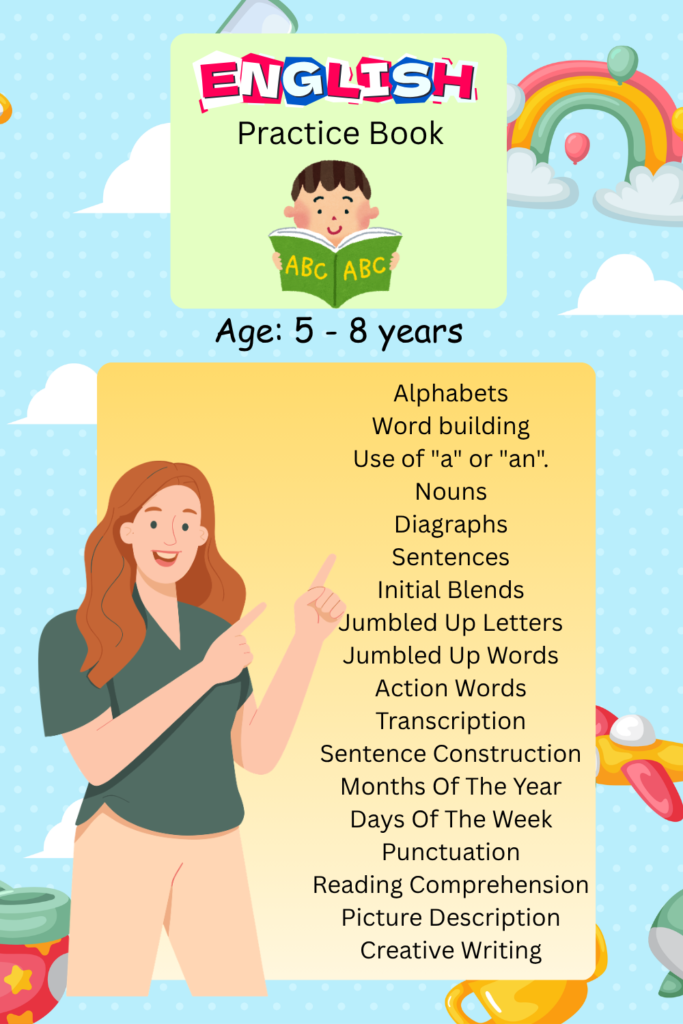
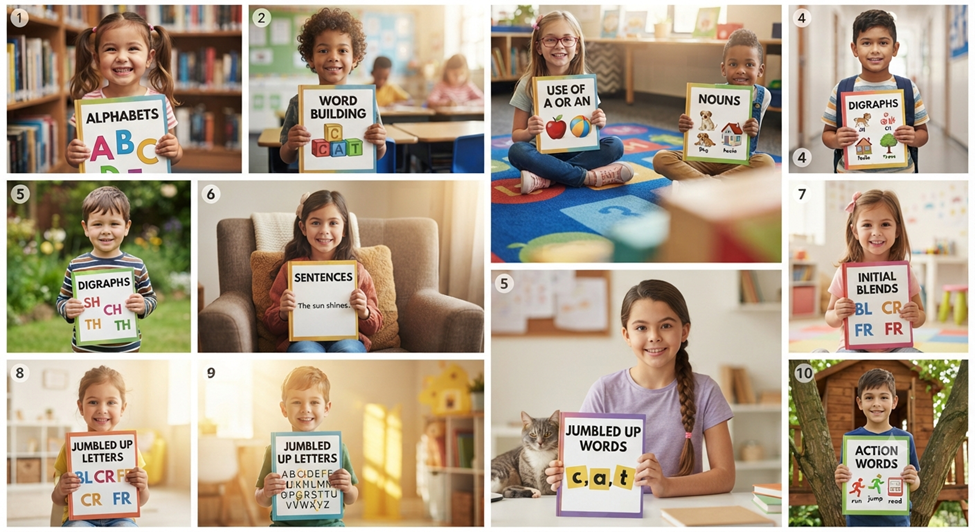
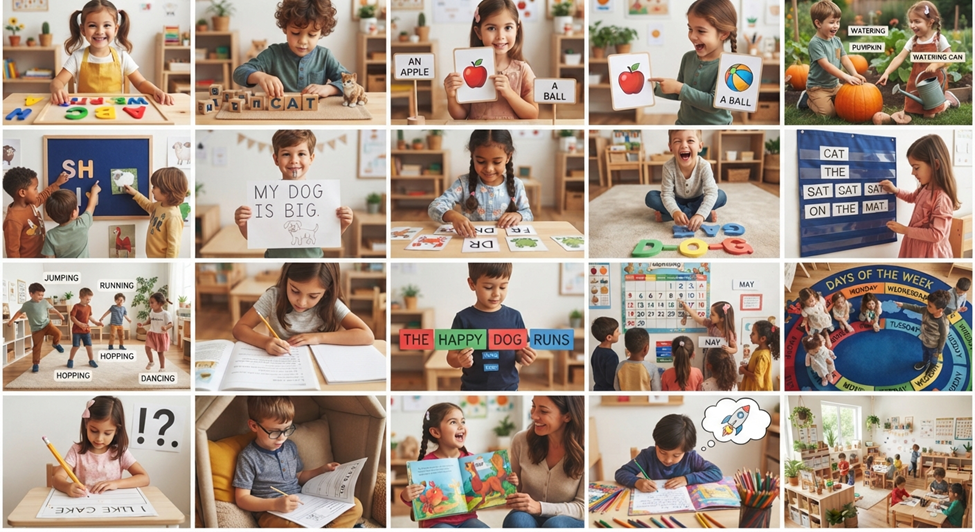
This isn’t just another stack of printable English worksheets. It’s a carefully sequenced program covering eighteen essential topics — from alphabet recognition all the way to creative writing. Each section builds on the last, so children aren’t just memorizing facts; they’re developing real literacy skills step by step.
Here’s a quick look at what’s covered:
- Alphabets
- Word Building
- Use of “A” and “An”
- Nouns
- Digraphs
- Sentences
- Initial Blends
- Jumbled Letters
- Jumbled Words
- Action Words (Verbs)
- Transcription
- Sentence Construction
- Months of the Year
- Days of the Week
- Punctuation
- Reading Comprehension
- Picture Description
- Creative Writing
Whether you’re a parent looking for extra practice at home or a teacher planning your weekly lessons, this English workbook PDF gives you a ready-made roadmap. No guesswork, no scattered resources — just one organized set of English activities for Grade 1 and younger learners.
Alphabet Activities in This English Workbook for Kids
Every literacy journey starts with the alphabet, and this section makes sure children don’t just recognize letters — they truly understand them. Kids practice identifying uppercase and lowercase letters, tracing letter shapes, and connecting each letter to a sound and a picture.
What your child learns: Letter recognition, correct letter formation, and the foundational sound-letter connection needed for reading.
Educational benefit: Strong alphabet knowledge is the single biggest predictor of later reading success. Children who master this early tend to pick up phonics and word building much faster.
Practical activity: Try a simple “Letter Hunt” — hide printed letters around the room and ask your child to find and name each one. It’s playful, active, and reinforces recognition without feeling like a lesson.
Foundational literacy skill developed: Print awareness and letter-sound correspondence.
Word Building Activities That Improve English Vocabulary
Once letters feel familiar, the next natural step is putting them together. This section focuses on blending sounds, decoding simple words, and practicing basic spelling patterns — all essential building blocks for reading fluency.
What your child learns: How to combine letters and sounds to form real words, along with early spelling strategies.
Educational benefit: Word building bridges the gap between knowing individual letters and reading full sentences. It also strengthens vocabulary, which supports comprehension later on.
Practical activity: Use magnetic letters or letter cards and ask your child to build three-letter words like “cat,” “sun,” or “dog.” Mix up the letters afterward and have them rebuild the word from memory.
Foundational literacy skill developed: Phonemic blending and decoding.
Grammar Worksheets for Kids – A, An, Nouns and Action Words
Grammar can feel intimidating even for adults, so this section breaks it down into small, digestible pieces. Children learn when to use “a” versus “an,” how to identify nouns (people, places, animals, and things), and how to recognize action words, or verbs, in simple sentences.
What your child learns: The basic building blocks of sentence structure — articles, nouns, and verbs — explained through familiar, everyday examples.
Educational benefit: Early grammar exposure helps children speak and write more clearly, setting them up for more advanced sentence work later in school.
Practical activity: Play “Spot the Noun” during a walk or car ride — call out objects you see and ask your child to name them, then sort them into people, places, or things.
Foundational literacy skill developed: Grammatical awareness and sentence structure recognition.
Phonics Workbook Activities – Digraphs and Initial Blends
This is where reading really starts to click. The phonics workbook section introduces digraphs (like “sh,” “ch,” and “th”) and initial blends (like “bl,” “cr,” and “st”), helping children decode trickier words with confidence.
What your child learns: How two letters can combine to make a single new sound, and how blended consonants work together at the start of words.
Educational benefit: Digraphs and blends account for a huge portion of the English language, so mastering them dramatically expands what a child can read independently.
Practical activity: Create a “Sound Sort” game — write words with different digraphs and blends on cards, and have your child sort them into piles based on the sound they hear at the start.
Foundational literacy skill developed: Advanced phonemic awareness and decoding fluency.
Sentence Construction Activities for Grade 1 English
With vocabulary and grammar basics in place, children are ready to build full sentences. This section covers sentence writing, jumbled letters, jumbled words, and transcription exercises that all work together to strengthen written expression.
What your child learns: How to arrange words in the correct order, copy sentences accurately, and unscramble jumbled letters or words to reveal meaning.
Educational benefit: These exercises train the brain to recognize sentence patterns, improving both reading fluency and writing accuracy at the same time.
Practical activity: Write a simple sentence on strips of paper, cut it into individual words, and ask your child to rearrange them in the correct order.
Foundational literacy skill developed: Syntax awareness and written sentence structure.
Reading Comprehension Worksheets That Build Confidence
Reading a passage is one skill; understanding it is another. This section includes short, age-appropriate passages followed by simple questions, along with practice on days of the week, months of the year, and punctuation — all skills that support fluent, meaningful reading.
What your child learns: How to read for meaning, answer questions about a text, and apply punctuation correctly when reading aloud or writing.
Educational benefit: Reading comprehension worksheets teach children to think about what they read rather than just decode words mechanically — a skill that pays off across every school subject.
Practical activity: After reading a short story together, ask three simple questions: “Who was in the story?”, “Where did it happen?”, and “What happened at the end?”
Foundational literacy skill developed: Reading comprehension and inferential thinking.
Picture Description and Creative Writing Activities for Kids
This section gives children room to express themselves. Picture description activities ask kids to describe what they see in an image using full sentences, while creative writing for kids exercises encourage short stories, simple journal entries, or imaginative prompts.
What your child learns: How to translate ideas and observations into written language, using vocabulary and grammar skills learned earlier in the book.
Educational benefit: Creative writing builds confidence, encourages self-expression, and helps children see writing as an enjoyable activity rather than a chore.
Practical activity: Show your child a picture from a magazine or book and ask them to write three sentences describing what’s happening in it.
Foundational literacy skill developed: Written expression and narrative thinking.
Printable English Worksheets for Daily Practice at Home and School
One of the best things about this workbook is its flexibility. Because every page is a ready-to-use printable English worksheet, it fits naturally into homeschool routines, classroom lesson plans, or even quiet weekend practice sessions.
Teachers can use individual sections to reinforce specific lessons, while parents can work through the book at their child’s own pace no rigid schedule required. This makes it just as useful for a classroom of twenty students as it is for one child learning at the kitchen table.
Why Parents and Teachers Love This English Workbook PDF
Here are more than 15 reasons families and educators keep coming back to this resource:
- Covers all 18 essential English topics in one place
- Suitable for Kindergarten, Preschool, Reception, UKG, and Grade 1
- Builds skills progressively, from letters to full sentences
- Strengthens phonics through digraphs and initial blends
- Introduces grammar concepts in a simple, age-appropriate way
- Encourages independent reading through comprehension practice
- Develops creative thinking through picture description and writing prompts
- Reinforces days of the week and months of the year
- Teaches basic punctuation naturally, not through memorization
- Provides hands-on practice with jumbled letters and words
- Works equally well for classroom teaching and homeschooling
- Requires no special materials beyond a pencil and printer
- Supports EEAT-aligned, research-based early literacy methods
- Keeps children engaged with varied, non-repetitive activities
- Gives parents a clear sense of their child’s progress
- Available as an easy-to-download English workbook PDF
- Designed by early years education specialists
Comparison Table: Workbook Topics and Learning Outcomes
| Workbook Topic | Learning Outcome |
| Alphabets | Letter recognition and sound-letter connection |
| Word Building | Blending letters into readable words |
| Use of “A” and “An” | Correct use of articles in speech and writing |
| Nouns | Identifying people, places, animals, and things |
| Digraphs | Recognizing two-letter sound combinations |
| Initial Blends | Decoding consonant blends at word starts |
| Sentences | Understanding basic sentence structure |
| Jumbled Letters | Strengthening spelling and letter order |
| Jumbled Words | Improving sentence sequencing skills |
| Action Words (Verbs) | Recognizing verbs in everyday sentences |
| Transcription | Practicing accurate copying and handwriting |
| Sentence Construction | Building grammatically correct sentences |
| Months of the Year | Learning calendar vocabulary and sequence |
| Days of the Week | Building time-related vocabulary |
| Punctuation | Using periods, question marks, and capitals correctly |
| Reading Comprehension | Understanding and analyzing short texts |
| Picture Description | Expressing observations in full sentences |
| Creative Writing | Developing imagination and written expression |
Frequently Asked Questions About This English Workbook for Kids
1. What age group is this English workbook for Class 1 designed for?
It’s designed for children in Kindergarten, Preschool, Reception, UKG, and Grade 1, generally between ages 3 and 7.
2. Is this workbook suitable for homeschooling?
Yes. The printable format and clear structure make it ideal for homeschool parents who want a complete, ready-to-use curriculum.
3. Does the workbook include phonics practice?
Yes, it includes a full phonics workbook section covering digraphs and initial blends to support reading fluency.
4. Can teachers use this in a classroom setting?
Absolutely. Many sections work well for whole-class instruction, small group activities, or independent practice stations.
5. Does the workbook cover grammar basics?
Yes, it introduces articles (“a” and “an”), nouns, and action words in a simple, age-appropriate way.
6. Is reading comprehension included?
Yes, short passages with follow-up questions help children practice reading for meaning, not just decoding.
7. What format does the workbook come in?
It’s available as a downloadable English workbook PDF that can be printed at home or in school.
8. Does it include creative writing practice?
Yes, picture description and creative writing exercises encourage children to express ideas in their own words.
9. How is this different from random English worksheets online?
Unlike scattered worksheets, this workbook follows a logical progression from basic letters to full sentence writing, ensuring no skill gaps.
10. Where can I buy this English workbook?
You can get the complete workbook directly from the Resource page of this website.. https://meblogger.com/resources/
External Authoritative Resources
- Reading Rockets (readingrockets.org) — research-based reading instruction guidance
- International Literacy Association ( literacyworldwide.org ) — literacy development research