

How to Teach Phonics to Children: Complete Guide
Learn how to teach phonics to children step by step with practical lessons, activities, games, and expert strategies for parents and teachers.
Learning to read is one of the biggest milestones in a child’s life, and phonics is the engine that makes it happen. If you’ve ever sat next to a five years old sounding out “c-a-t” for the first time and watched their face light up when it finally clicks, you already know how powerful this moment is. This guide will show you exactly how to teach phonics to children, from the very first letter sound all the way to confident, independent reading.
Whether you’re a preschool teacher planning your first phonics unit, a kindergarten or first-grade teacher looking for a stronger sequence, or a homeschooling parent who wants a clear roadmap, this article gives you a complete teaching framework you can start using today.

What Phonics Actually Is
Phonics is the method of teaching children to connect sounds (phonemes) with letters or groups of letters (graphemes), and then to blend those sounds together to read words. It’s the bridge between spoken language, which children already understand, and written language, which they’re learning to decode.
Why Phonics Matters
Decades of reading research often summarized under the term “the science of reading”—show that systematic, explicit phonics instruction is one of the most reliable ways to help children become confident readers. Without it, children are left guessing at words based on pictures or context, a strategy that works for a while and then quietly falls apart once texts get harder.
Think of phonics as giving a child a code-breaking key. English spelling can look chaotic on the surface, but it’s actually built from a limited set of predictable letter-sound patterns. Once a child holds that key, they can unlock thousands of words on their own instead of depending on an adult to tell them what a word says. This independence is what turns a child from someone who is “read to” into someone who reads.
There’s also a compounding effect worth knowing about. Children who decode fluently early on read more, and children who read more get better at reading researchers sometimes call this the “Matthew effect” in literacy. Strong phonics instruction in the early years helps set that positive cycle in motion, rather than letting a child fall further behind their peers each year. https://www.thenationalliteracyinstitute.com/
The Ideal Age to Start Phonics Instruction
Most children are ready for formal phonics instruction between ages 4 and 6, though informal groundwork rhyming, listening games, and letter play can start as early as age 3. There’s no need to rush a two- or three years old into letter sounds. What matters far more at that age is rich talk, books, songs, and play.
Common Mistakes Adults Make
- Teaching letter names before letter sounds
- Moving to new sounds before old ones are secure
- Skipping blending practice and jumping straight to whole words
- Using books that aren’t decodable, so children rely on guessing
- Making lessons too long, too formal, or too stressful
Keep these in mind as we go we’ll return to each one.
How This Guide Is Different
Most articles online explain what phonics is and stop there. This guide goes further. You’ll walk away with an actual sequence to follow, a ready made 20 minute daily lesson plan, a full week’s schedule, more than 20 hands-on activities, and answers to the questions parents and teachers ask most. Think of it as a start to finish teaching framework rather than a definitions page.
What Is Phonics?
Before teaching phonics, it helps to understand the building blocks you’re working with.
- Letters are the written symbols: a, b, c, d…
- Sounds (phonemes) are the smallest units of spoken sound in a word. The word “cat” has three phonemes: /c/ /a/ /t/.
- Graphemes are the written representation of a sound. A grapheme can be one letter (s), two letters (sh), or even more (igh).
- Blending means pushing individual sounds together to read a word: c-a-t → cat.
- Segmenting means breaking a spoken word into its individual sounds: cat → c-a-t. This is the core skill needed for spelling.
- Digraphs are two letters that make one sound: sh, ch, th, ck, ng.
- Trigraphs are three letters that make one sound: igh (as in “night”), tch (as in “watch”).
Here’s a simple example to anchor all of this: the word ship has four letters but only three sounds: /sh/ /i/ /p/, because “sh” is a digraph representing a single phoneme.
Skills Children Need Before Learning Phonics
Phonics doesn’t start with letters it starts with the ear. Children need a foundation of phonemic awareness and general readiness skills before letter-sound instruction will make sense to them.
- Listening skills – the ability to sit and attend to sounds around them
- Auditory discrimination – noticing the difference between similar sounds (e.g., “pat” vs. “bat”)
- Rhyming – recognizing that “cat,” “hat,” and “mat” share an ending sound
- Syllable awareness – clapping out the beats in words like “el-e-phant”
- Vocabulary development – the more words a child knows and uses, the easier reading comprehension becomes later
- Fine motor skills – strengthening the hand muscles needed to eventually hold a pencil
- Print awareness – understanding that print carries meaning, that we read left to right, and that a book has a front and back
If a child struggles with phonics instruction, it’s often worth stepping back and strengthening these pre-reading skills first, rather than pushing forward with more letters.
The Correct Order for Teaching Phonics
Phonics should always follow a logical, cumulative sequence. Teaching sounds in a random order or introducing several look alike letters at once (like b and d) creates confusion.
| Stage | Skill | Examples |
| Stage 1 | Letter sounds | s, a, t, p |
| Stage 2 | Blending | sat, pat |
| Stage 3 | Segmenting | cat → c-a-t |
| Stage 4 | Digraphs | sh, ch, th |
| Stage 5 | Tricky (sight) words | was, said |
Many well-known synthetic phonics programs (such as those inspired by Letters and Sounds) begin with the letters s, a, t, p, i, n because they combine to form the largest number of real, decodable words almost immediately—”sat,” “pat,” “tap,” “pin,” “sit,” and more.
Step 1 – Teach Letter Sounds
Why Sounds Should Be Taught Before Letter Names
When a child learns that the letter “s” is called “ess” before they know it makes the sound /s/, it actually slows down reading. Reading requires sound knowledge, not name knowledge. Teach the sound first (“this letter says /s/, like in snake”), and introduce the letter’s name later, once reading is underway.
How Many Sounds to Teach Each Week
For most children aged 4–6, 2 to 4 new sounds per week is a manageable, sustainable pace. Moving faster than this often means sounds aren’t fully secure before new ones pile on top.
Correct Pronunciation
This is one of the most overlooked details in phonics instruction. Sounds should be pure, without an added “uh” sound at the end.
- Say /s/, not “suh”
- Say /t/, not “tuh”
- Say /m/, not “muh”
This single habit makes an enormous difference when children start blending, because “s-uh-a-uh-t-uh” is nearly impossible to blend into “sat,” while pure sounds blend smoothly.
Activities for Teaching Letter Sounds
- Sound of the day – introduce one sound with a picture, an action, and a simple phrase (“s says /s/ like snake”)
- Sound hunt – search the room or house for objects starting with the target sound
- Flashcard flash – quick-fire review of 5–6 known sounds each day
- Sound sorting – sort small toys or pictures by their beginning sound
Step 2 – Teach Letter Formation
Reading and writing develop together, so letter formation deserves its own dedicated attention rather than being an afterthought.
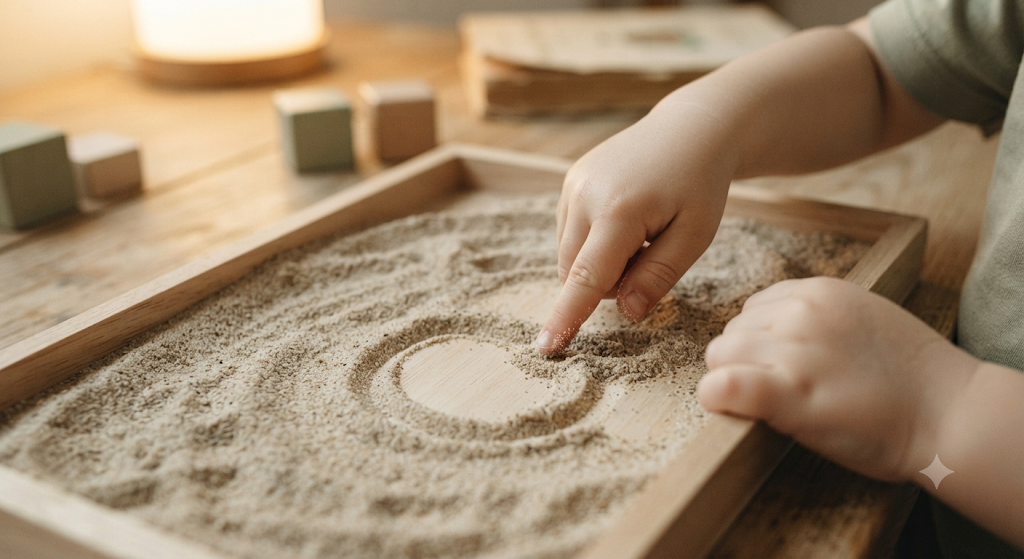
- Pencil grip – model a comfortable tripod grip early, using chunky pencils or crayons for small hands
- Air writing – trace giant letters in the air with a whole arm movement while saying the sound aloud
- Sand tracing – write letters in a shallow tray of sand, rice, or salt for multisensory practice
- Play dough activities – roll play dough into snakes and shape them into letters, building hand strength at the same time
Multisensory practice like this cements the letter shape far better than worksheets alone, especially for younger or more active learners.
Step 3 – Teach Blending
Blending is the single most important skill in early reading it’s the moment isolated sounds become a real word.
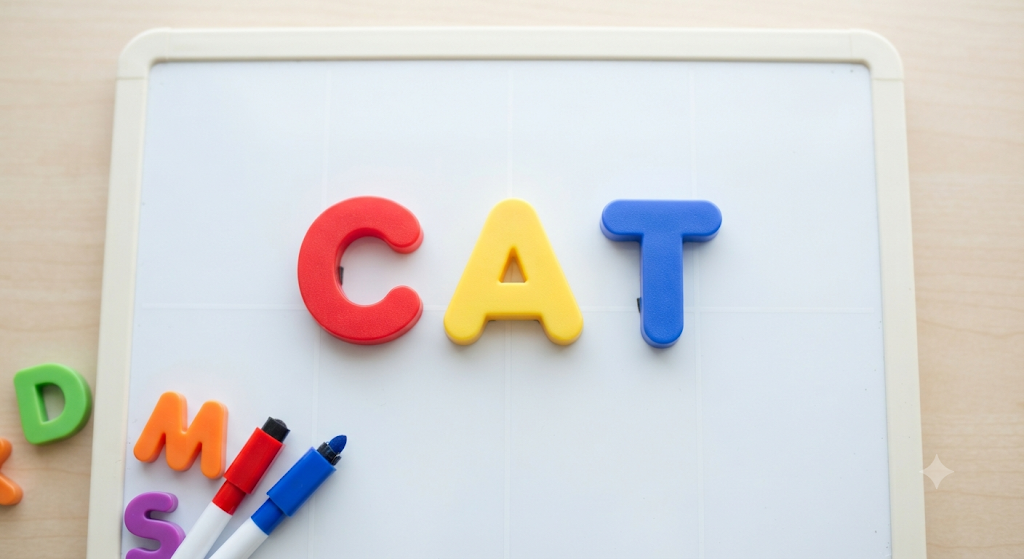
Example: c – a – t → cat
Model it slowly at first: say each sound with a short pause, then say them faster and faster until they merge into the word. Many teachers use a hand movement sliding a finger under each letter to show children how the sounds “travel” together.
Blending Games
- Robot talk – say a word in a slow, robotic voice (c-a-t) and have the child blend it back into a real word
- Hop and read – place large letter cards on the floor; the child hops on each one, saying the sound, then blends them together at the end
- Puppet blending – a puppet “speaks” in sounds, and the child translates for it
- Blend and build – use magnetic letters to build simple words, sounding out each one while sliding it into place
Step 4 – Teach Segmenting
If blending is reading, segmenting is spelling. It’s the reverse skill: taking a spoken word apart into its sounds.
Example: cat → c – a – t
Practical Activities
- Sound counting – say a word and have the child hold up a finger for each sound they hear
- Robot arms – say a word one sound at a time with a small arm movement per sound, then have the child guess the word
- Segmenting boxes – draw a box for each sound in a word and have the child write one letter per box
- Silent segmenting – whisper a word slowly, encouraging the child to “feel” each sound before writing
Step 5 – Teach Digraphs and Trigraphs
Once single letter sounds are secure, it’s time to introduce sounds made by two or three letters together. These should be taught one at a time, with plenty of blending practice for each.
| Digraph/Trigraph | Example Words |
| sh | ship, fish, shop |
| ch | chip, lunch, chat |
| th | that, bath, this |
| ck | duck, sock, back |
| ng | ring, song, sing |
| ai | rain, snail, paint |
| ee | tree, sheep, bee |
| oa | boat, coat, road |
| igh | night, light, high |
A useful technique is to underline or highlight the digraph in a word so children visually recognize it as “one sound, one unit” rather than trying to sound out each letter separately.
Step 6 – Introduce Sight Words
Why They Are Important
Not every word in English can be sounded out using regular phonics rules. Words like “said,” “was,” and “the” break the normal pattern and need to be recognized on sight. These are often called tricky words or sight words.
How to Teach Them Effectively
- Introduce only a few sight words at a time (3–5 per week)
- Point out which part of the word is irregular and which part is phonically regular (in “said,” only the “ai” is tricky s and d are normal sounds)
- Use repetition through flashcards, sentence building, and reading in context
- Avoid teaching sight words purely through memorization drills alone embedding them in real reading is far more effective long term
Step 7 – Use Decodable Readers
What Decodable Books Are
Decodable books are early readers written specifically to use only the letter sounds and sight words a child has already been taught. This means a child can genuinely read the book independently, using phonics skills, rather than guessing from pictures.
How to Select Them
- Choose books that match the exact sounds your child has learned so far
- Avoid books with lots of unfamiliar or untaught spelling patterns
- Look for simple, repetitive sentence structures in early titles
How to Use Them
- Let the child do the reading resist the urge to read it for them
- Praise sounding-out attempts, even if slow
- Re-read favorite decodable books multiple times to build fluency and confidence
- Discuss the story afterward to build comprehension alongside decoding
A Complete Daily 20-Minute Phonics Lesson Plan
Consistency matters more than length. A focused 20-minute daily lesson beats an occasional 90-minute session.
- Warm-up (3 minutes): A quick song, rhyme, or movement game to get focus and energy going.
- Sound revision (3 minutes): Flash through 5–8 previously learned sounds for quick recall.
- New sound (4 minutes): Introduce today’s new sound with a picture, action, and example word.
- Blending practice (4 minutes): Build and blend 3–5 words using the new sound plus known sounds.
- Reading activity (3 minutes): Read a short decodable sentence or page containing the target sound.
- Writing activity (3 minutes): Practice writing the new letter and one or two simple words.
Weekly Phonics Teaching Schedule
| Day | Focus | Activity |
| Monday | Introduce new sound | Sound of the day + air writing |
| Tuesday | Blending practice | Robot talk + word building |
| Wednesday | Segmenting practice | Sound counting + spelling boxes |
| Thursday | Reading application | Decodable book reading |
| Friday | Review and games | Phonics games + informal check-in |
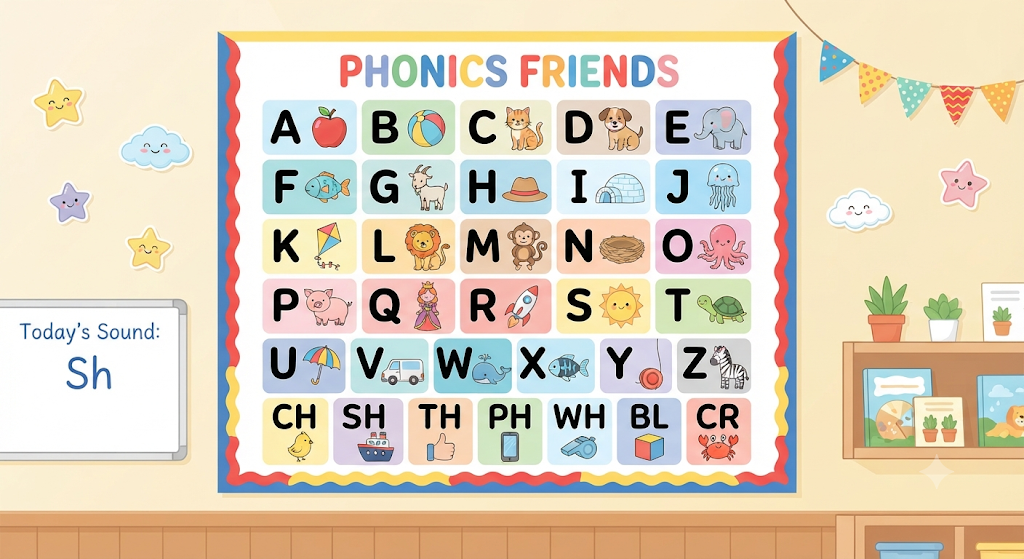
Fun Phonics Activities and Games
Practice sticks when it’s playful. Here are more than 20 activities to keep phonics lessons lively.
- Sound hunt – find objects around the room starting with a target sound
- Hop and read – hop across floor letters, blending as you go
- Sound bingo – call out sounds, children mark matching letters on a bingo card
- Mystery box – pull objects from a box and name the beginning sound
- Sound sorting – sort picture cards by beginning or ending sound
- Letter fishing – “catch” magnetic letters with a toy fishing rod, then say the sound
- Sand tray writing – trace letters in sand while saying the sound aloud
- Robot talk – say words in segmented “robot” sounds for children to blend
- Word building blocks – build words using magnetic or foam letters
- Bean bag toss – toss a bean bag onto a floor letter and say its sound
- Sound of the week collage – cut out magazine pictures that start with the target sound
- Silly sentence swap – swap one sound in a sentence to make it silly, then identify the change
- Phonics scavenger hunt – hide letter cards around a room or yard
- Clap the syllables – clap out syllables in names and objects
- Rhyme time – find rhyming pairs among picture cards
- Sound snap – a card game matching pictures to beginning sounds
- Chalk sound hop – write letters in chalk outside and hop while saying sounds
- Alphabet soup – “fish” plastic letters out of a sensory bin of water or rice
- Blend and build race – time how fast a child can build and blend three words
- Digraph detectives – search a book for words containing a specific digraph
- Sound puppets – puppets that “say” a sound the child must identify or blend
- Word ladder – change one sound at a time to make a new word (cat → cap → cup)
Common Phonics Teaching Mistakes
- Teaching letter names before sounds – slows down early blending; always start with sounds
- Moving too fast – introducing new sounds before old ones are automatic leads to confusion
- Skipping blending practice – children need repeated, explicit blending modeling, not just isolated sound drills
- Using non-decodable books too early – this encourages picture-guessing instead of genuine decoding
- Overly long or overly formal lessons – short, playful, consistent sessions outperform long, tense ones
- Adding a vowel sound to consonants – saying “tuh” instead of /t/ makes blending harder, not easier
- Ignoring individual pace – some children need more repetition on certain sounds before moving on; that’s normal, not a failure
How to Track a Child’s Phonics Progress
Progress in phonics isn’t always obvious day to day, so it helps to check in on specific, observable markers rather than relying on a general feeling of “how it’s going.”
- Keep a simple sound checklist. List every sound taught so far and mark whether the child recognizes it instantly, hesitates, or doesn’t yet know it. Revisit hesitant sounds more often.
- Time quick sound recall. A child who takes more than two or three seconds to recall a taught sound likely needs more review before new sounds are added.
- Listen for blending fluency. A child who blends “sat” smoothly, without long pauses between each sound, has moved from effortful decoding toward automatic reading.
- Watch spelling attempts. Segmenting ability often shows up first in writing if a child can write “dog” as d-o-g independently, their segmenting skill is solidly in place.
- Note which decodable books feel easy. If a child races through a book with no hesitation and full understanding, it may be time to move to the next level.
Small, regular check-ins like these help you decide when to move forward and when to slow down, which matters far more than following a rigid, one size fits all timeline.
Frequently Asked Questions
What age should children start phonics?
Most children are ready for structured phonics instruction between ages 4 and 6, though informal listening and rhyming activities can begin as early as age 3.
How long should phonics lessons be?
Around 15–20 minutes a day is ideal for young children. Short, consistent, daily practice works better than long, infrequent sessions.
Which sounds should be taught first?
Many effective programs start with s, a, t, p, i, n, since these six letters combine to form dozens of simple, real, decodable words almost right away.
How can parents teach phonics at home?
Start with sound games (not letter names), model pure sounds, practice blending daily with simple three-letter words, and read decodable books together, letting the child do as much of the sounding-out as possible.
Do children need to know the alphabet before starting phonics?
No. In fact, it’s often more effective to teach a small set of letter sounds and start blending words immediately, introducing the rest of the alphabet and letter names gradually alongside this.
What’s the difference between phonics and phonemic awareness?
Phonemic awareness is an oral skill hearing and manipulating sounds in spoken words without seeing print. Phonics connects those sounds to written letters. Phonemic awareness typically comes first and supports phonics learning.
How do I know if my child is ready to move to the next stage?
Look for automaticity: if a child can recall a sound instantly, blend it into simple words without hesitation, and use it correctly in reading and writing, they’re ready to move forward.
Conclusion
Teaching phonics doesn’t require a teaching degree or an expensive curriculum it requires a clear sequence, a little patience, and consistent daily practice. Start with sounds, not letter names. Build blending and segmenting side by side. Introduce digraphs gradually. Use real decodable books so children experience the reward of genuine reading. Most importantly, keep it playful, keep it short, and celebrate every small win along the way. Confident readers aren’t built in a single afternoon they’re built one sound, one blend, and one book at a time.