

Discover 20 speech activities for 3–5-year olds that build language skills plus expert tips for home and preschool.
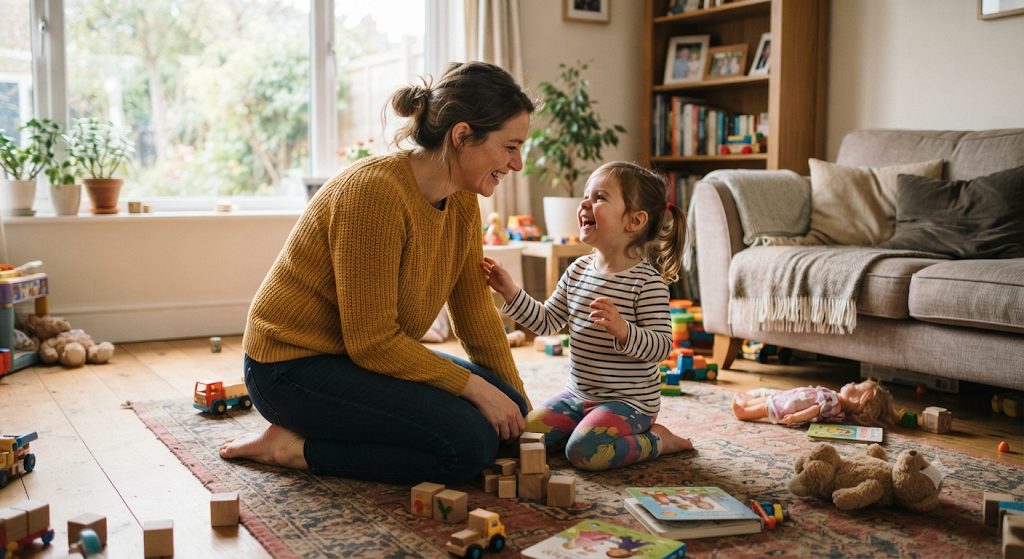
“My child understands everything I say but barely talks back.” “My preschoolers can say the words, but half the class can’t understand them.” If either sentence sounds familiar, you’re not alone and you’re in the right place.
Between ages 3 and 5, children make some of the fastest language gains of their entire lives. This is the window when vocabulary explodes, sentences get longer, and kids start using words to negotiate, joke, and problem-solve instead of just naming things. It’s also a window where gaps become more noticeable: a limited vocabulary, speech that’s hard to understand, trouble following two-step directions, difficulty asking for what they need, or listening skills that seem to drift in and out.
The good news is that speech and language grow best through play, not drills. A few minutes of the right kind of talk, woven into a game or a daily routine, does more than a worksheet ever could. Below, you’ll find 20 speech activities for 3–5-year-olds that are simple to set up, backed by early-childhood and speech-language practice, and just as useful for parents at the kitchen table as for teachers running circle time.
Quick Tips Box
- Aim for 10–15 minutes of focused talk-play daily — little and often beats one long session.
- Get face-to-face. Children pick up more from your mouth and expression when they can see you clearly.
- Follow the child’s interest first, then add the language goal.
- Pause and wait. Silence gives a child room to respond.
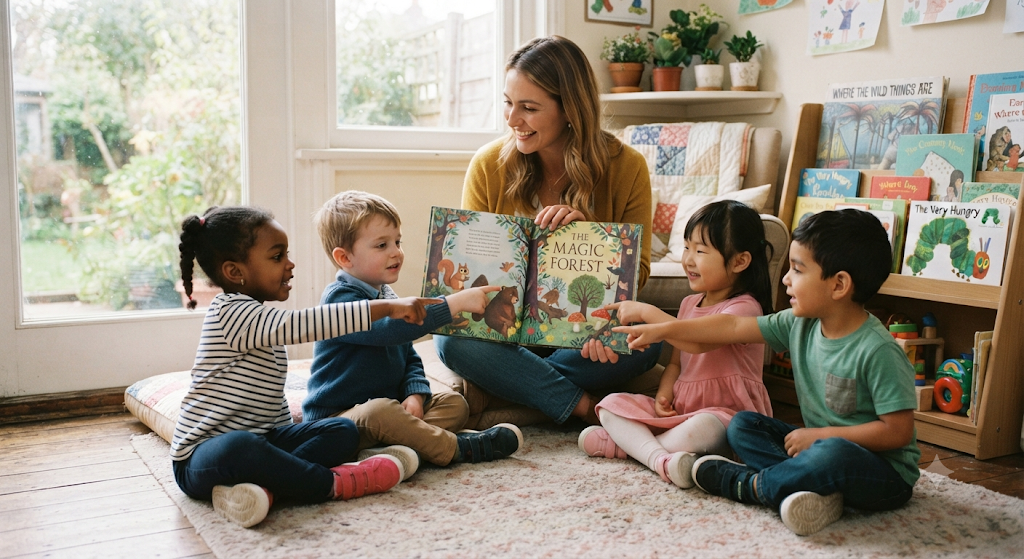
Why Speech and Language Development Matters Between Ages 3 and 5
This stretch of early childhood lays the foundation for almost everything that follows in school and social life.
- Vocabulary growth: Preschoolers typically move from a few hundred words to well over a thousand, and start understanding words in categories, not just isolated labels.
- Sentence development: Children shift from two- and three-word phrases to fuller sentences with grammar markers like plurals, past tense, and connecting words.
- Listening skills: Following two- and three-step directions becomes possible, which matters enormously for classroom routines.
- Confidence: Children who can make themselves understood are more willing to try talking to new people and take social risks.
- Social communication: Turn-taking in conversation, asking questions, and responding to peers all develop rapidly in this age range.
- School readiness: Oral language is one of the strongest predictors of later reading and writing success, since it underpins phonological awareness and comprehension.
Signs Your Child May Need Extra Speech Support
Every child develops at a slightly different pace, but certain patterns are worth paying attention to:
- By age 3: very few word combinations, speech that’s largely unintelligible even to family, or frequent frustration when trying to communicate.
- By age 4: still mostly using single words or short phrases, ongoing difficulty being understood by unfamiliar adults, or trouble following simple two-step directions.
- By age 5: noticeably limited vocabulary compared to peers, persistent sound errors that affect clarity, or difficulty forming complete sentences.
These are general patterns, not a diagnosis — only a certified speech-language pathologist (SLP) can properly assess a child’s speech and language skills. If you notice several of these signs, or your instincts are telling you something isn’t quite right, a screening with a licensed SLP is the right next step. The American Speech-Language-Hearing Association (ASHA) and the CDC’s developmental milestones checklists are useful starting references for parents and teachers alike.
20 Fun Speech Activities for 3–5-Year-Olds
Each activity below can be adapted up or down depending on your child’s current level. Materials are intentionally simple — most use things you already have at home or in a classroom.
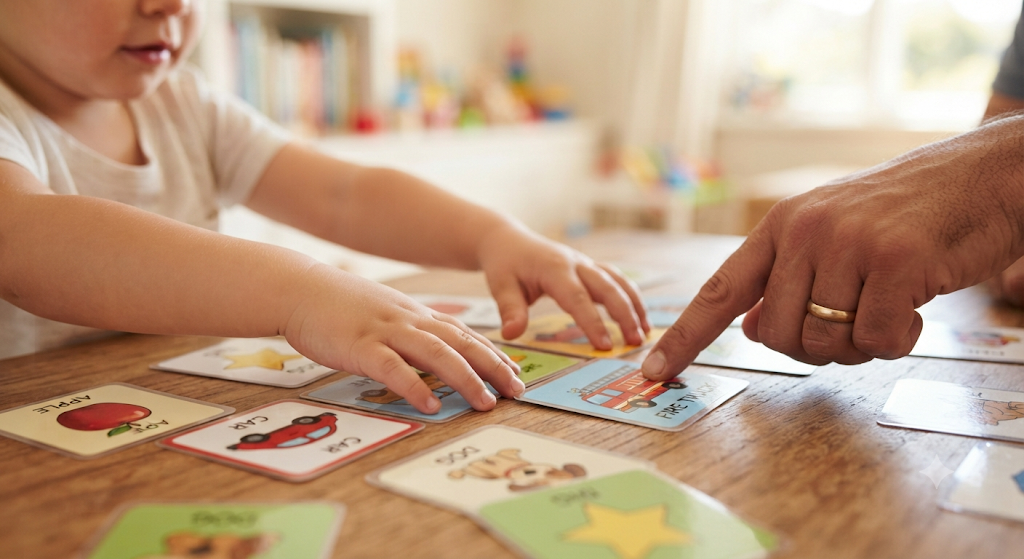
1. Picture Naming
Recommended Age: 3–4
| Learning Goal: Expand expressive vocabulary |
Skill Developed: Naming/word retrieval |
Materials: Picture cards, magazine cutouts, or a picture book
Instructions: Show one picture at a time. Ask “What’s this?” and wait. Name it if the child doesn’t, then have them repeat it. Easier: Offer two choices (“Is it a cat or a dog?”).
More Challenging: Ask the child to describe the picture in a full sentence.
Teacher Tip: Rotate cards weekly to reinforce categories like food, animals, and clothing.
Parent Tip: Use photos from a recent outing for extra motivation.
Example Conversation: “What’s this?” “Ball!” “Yes, a big red ball!”
Skills Practiced: Vocabulary, articulation |
Estimated Time: 5–10 minutes
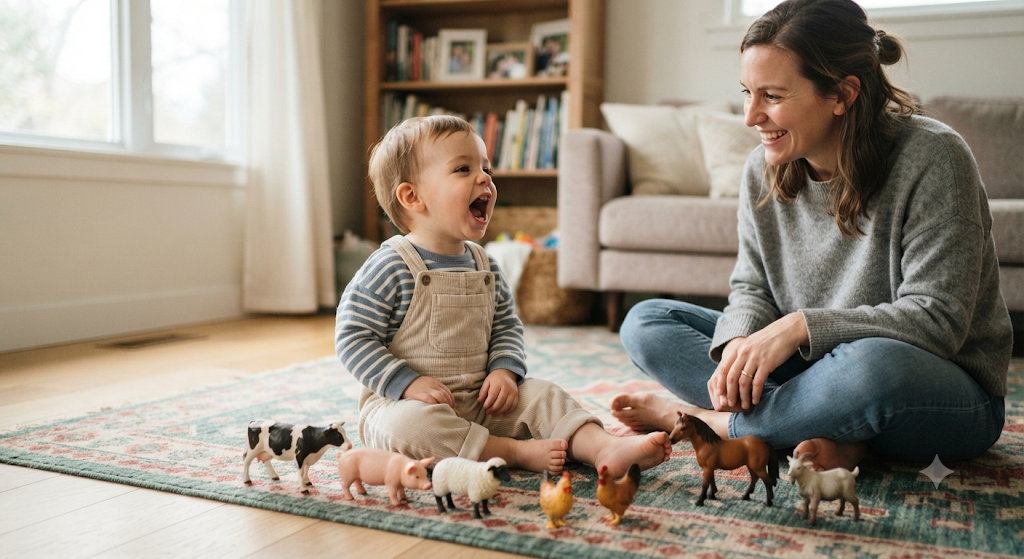
2. Animal Sounds
Recommended Age: 3 |
Learning Goal: Sound imitation and vocabulary |
Skill Developed: Oral-motor imitation |
Materials: Toy animals or animal picture cards
Instructions: Hold up an animal and make its sound together. Ask, “What does a cow say?”
Easier: Model the sound first every time.
More Challenging: Ask the child to name the animal after hearing only the sound.
Teacher Tip: Use during transitions to keep the group engaged.
Parent Tip: Turn it into a bedtime “guess the sound” game.
Example Conversation: “Moo! What animal is that?” “Cow!”
Skills Practiced: Sound production, listening |
Estimated Time: 5 minutes
3. Story Retelling
Recommended Age: 4–5 |
Learning Goal: Sequencing and narrative skills |
Skill Developed: Story structure, sentence formation |
Materials: A short picture book Instructions: Read a short story, then ask the child to retell it using the pictures as prompts. Easier: Ask yes/no or “what happened next” prompts.
More Challenging: Have the child retell without looking at the pictures.
Teacher Tip: Use a “first, then, next, last” chart.
Parent Tip: Retell the story from memory at bedtime.
Example Conversation: “What happened first?” “The bear woke up.”
Skills Practiced: Sequencing, memory, sentence length |
Estimated Time: 10 minutes
4. Simon Says
Recommended Age: 4–5 |
Learning Goal: Following directions |
Skill Developed: Auditory processing, listening |
Materials: None
Instructions: Give one- to two-step directions starting with “Simon says.” Skip the phrase occasionally to check listening. Easier: Use one-step directions only.
More Challenging: Add three-step directions (“touch your nose, then clap, then sit”).
Teacher Tip: Great for whole-group transitions.
Parent Tip: Play in the car using seated actions.
Example Conversation: “Simon says touch your toes!”
Skills Practiced: Listening comprehension, direction-following |
Estimated Time: 5–10 minutes
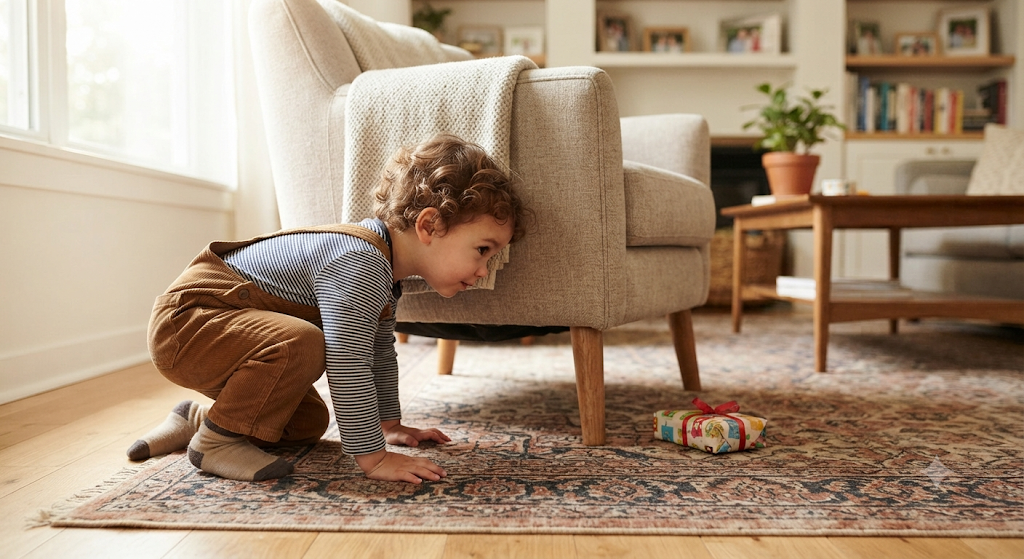
5. Treasure Hunt with Directions
Recommended Age: 4–5 |
Learning Goal: Understanding positional and sequential language |
Skill Developed: Direction-following, vocabulary (prepositions) |
Materials: A small toy, hiding spots
Instructions: Give clues using position words: “Look under the chair,” “Look behind the door.”
Easier: Point while giving the clue.
More Challenging: Give two clues in a row without pointing.
Teacher Tip: Use classroom furniture as landmarks.
Parent Tip: Hide a favorite snack as the prize.
Example Conversation: “It’s next to the lamp.” “Found it!”
Skills Practiced: Prepositions, listening |
Estimated Time: 10 minutes
6. Rhyming Games
Recommended Age: 4–5 |
Learning Goal: Phonological awareness |
Skill Developed: Sound pattern recognition |
Materials: None or rhyming picture cards
Instructions: Say a word and ask the child to think of a word that rhymes, or pick the rhyming picture from a set.
Easier: Offer a choice of two words, one rhyming.
More Challenging: Ask the child to generate a new rhyme independently.
Teacher Tip: Pair with a rhyming picture book like nursery rhymes.
Parent Tip: Play during bath time with rubber duck rhymes.
Example Conversation: “Cat… rhymes with… hat!”
Skills Practiced: Phonological awareness, pre-reading skills |
Estimated Time: 5–10 minutes
7. Mystery Bag
Recommended Age: 3–5 |
Learning Goal: Descriptive language |
Skill Developed: Vocabulary, descriptive sentences |
Materials: A bag and 5–6 small objects
Instructions: Child reaches in, feels an object without looking, and describes it before guessing what it is.
Easier: Allow a peek after guessing.
More Challenging: Require a full sentence description before guessing.
Teacher Tip: Rotate objects to match a weekly theme.
Parent Tip: Use kitchen items for an easy at-home version.
Example Conversation: “It’s hard and round.” “A ball!”
Skills Practiced: Descriptive vocabulary, tactile-language link |
Estimated Time: 10 minutes
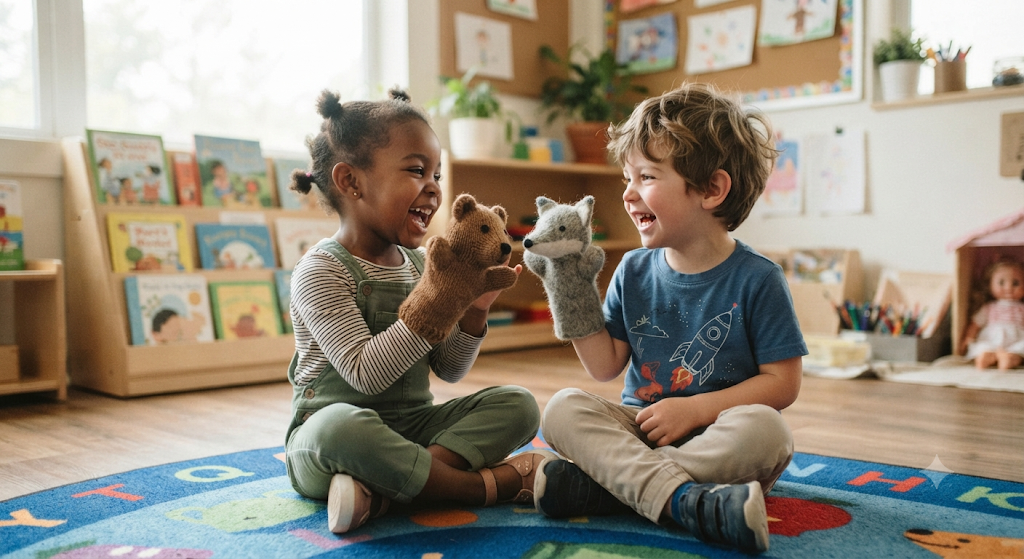
8. Puppet Conversations
Recommended Age: 3–4 |
Learning Goal: Conversational turn-taking |
Skill Developed: Social communication |
Materials: Two hand puppets or socks
Instructions: Use puppets to model a simple back-and-forth conversation, then hand one puppet to the child.
Easier: Model both sides first, child just repeats a line.
More Challenging: Child improvises the puppet’s response.
Teacher Tip: Great for shy children who find puppets less intimidating.
Parent Tip: Act out the child’s day through the puppet’s “voice.”
Example Conversation: “Hi, I’m Ducky. What’s your name?” “I’m Sam!”
Skills Practiced: Turn-taking, pragmatic language |
Estimated Time: 10 minutes
9. Sound Imitation
Recommended Age: 3 |
Learning Goal: Articulation practice |
Skill Developed: Speech sound production |
Materials: None
Instructions: Model a target sound in a fun context (e.g., “ssss” like a snake) and have the child imitate it.
Easier: Focus on one sound repeated playfully.
More Challenging: Combine the sound into simple words.
Teacher Tip: Pair sounds with matching animal or vehicle pictures.
Parent Tip: Practice during pretend play with toy cars (“vroom”) or snakes.
Example Conversation: “Can you make the snake sound? Ssss!”
Skills Practiced: Articulation, oral-motor control |
Estimated Time: 5 minutes
10. Action Songs
Recommended Age: 3–4 |
Learning Goal: Vocabulary and following along |
Skill Developed: Listening, sequencing, vocabulary |
Materials: None
Instructions: Sing songs with matching actions, such as “Head, Shoulders, Knees and Toes.”
Easier: Slow the song down and exaggerate actions.
More Challenging: Have the child lead and name the next body part.
Teacher Tip: Great transition-time filler.
Parent Tip: Use bath time for a “wash your…” version.
Example Conversation: “Head, shoulders, knees and toes!”
Skills Practiced: Vocabulary, listening, rhythm |
Estimated Time: 5 minutes
11. Role Play
Recommended Age: 4–5 |
Learning Goal: Functional and social language |
Skill Developed: Pragmatic language, vocabulary |
Materials: Dress-up clothes, play kitchen, or simple props
Instructions: Set up a pretend scenario (doctor, shop, restaurant) and take turns playing roles, modeling relevant phrases. Easier: Provide a script of key phrases to repeat.
More Challenging: Let the child direct the scenario and invent dialogue.
Teacher Tip: Rotate dramatic play themes monthly to expand topic-specific vocabulary.
Parent Tip: Use a pretend “store” with household items and play money.
Example Conversation: “Welcome to my restaurant! What would you like to order?”
Skills Practiced: Social language, vocabulary, sentence structure |
Estimated Time: 15 minutes
12. Obstacle Course with Directions
Recommended Age: 4–5 |
Learning Goal: Following multi-step directions |
Skill Developed: Auditory memory, sequencing |
Materials: Cushions, chairs, tape on the floor
Instructions: Set up a simple course and give verbal directions for each step (“crawl under, jump over, then run to the door”). Easier: Give one direction at a time.
More Challenging: Give three-step directions before the child starts moving.
Teacher Tip: Use for gross-motor and language integration during outdoor time.
Parent Tip: Build a course with couch cushions on a rainy day.
Example Conversation: “First crawl under the table, then jump twice.”
Skills Practiced: Listening, sequencing, direction-following |
Estimated Time: 10–15 minutes
13. Category Sorting
Recommended Age: 3–5 |
Learning Goal: Categorization and vocabulary organization |
Skill Developed: Semantic language, reasoning |
Materials: Picture cards or small objects
Instructions: Sort items into categories like food vs. toys, or ask “which one doesn’t belong?”
Easier: Sort into two obvious categories.
More Challenging: Sort into three or four subtle categories, or explain why an item belongs.
Teacher Tip: Tie categories to the weekly classroom theme.
Parent Tip: Sort laundry by color or type together while naming items.
Example Conversation: “Is an apple a fruit or a toy?” “Fruit!”
Skills Practiced: Categorization, vocabulary, reasoning |
Estimated Time: 10 minutes
14. Guess the Object
Recommended Age: 4–5 |
Learning Goal: Descriptive and inferential language |
Skill Developed: Vocabulary, reasoning, question-asking |
Materials: Household objects
Instructions: Give clues about an object one at a time; the child guesses, asking questions if needed.
Easier: Give three clear clues right away.
More Challenging: Child must ask yes/no questions to figure it out.
Teacher Tip: Use as a calm-down or transition activity.
Parent Tip: Play at the dinner table with food items.
Example Conversation: “It’s yellow and you peel it.” “A banana!”
Skills Practiced: Descriptive language, reasoning |
Estimated Time: 10 minutes
15. Bubble Talk
Recommended Age: 3 |
Learning Goal: Requesting and simple sentences |
Skill Developed: Functional communication |
Materials: Bubble solution and wand
Instructions: Blow bubbles, then pause and wait for the child to request “more” or “pop” before continuing.
Easier: Accept a single word like “more.”
More Challenging: Require a full sentence like “Blow more bubbles, please.”
Teacher Tip: Excellent for building anticipation and turn-taking outdoors.
Parent Tip: Use as a calm outdoor bonding activity.
Example Conversation: “More bubbles, please!” “Okay, here you go!”
Skills Practiced: Requesting, sentence building |
Estimated Time: 10 minutes
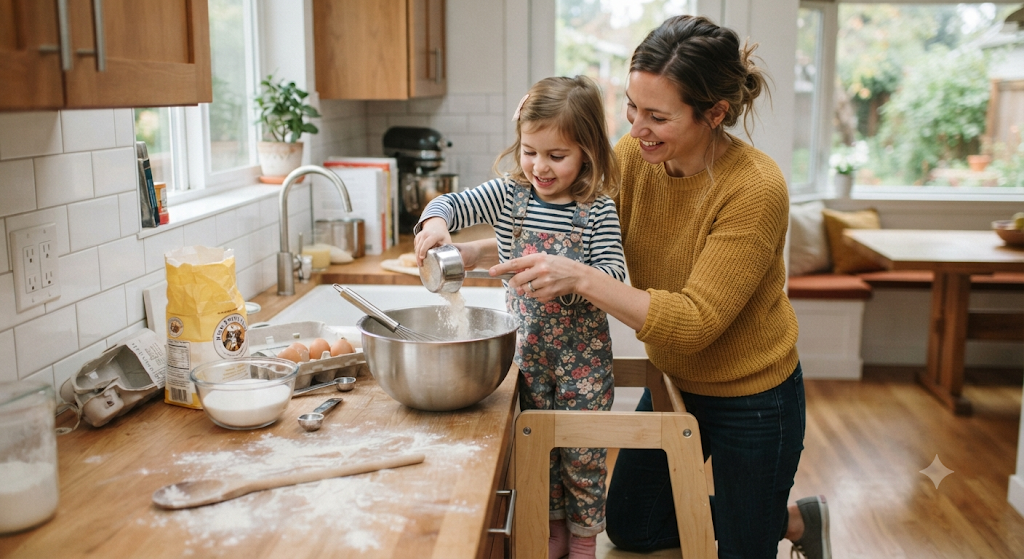
16. Cooking Together
Recommended Age: 4–5 |
Learning Goal: Following steps and vocabulary in context |
Skill Developed: Sequencing, descriptive vocabulary |
Materials: A simple, safe recipe
Instructions: Narrate each cooking step and have the child repeat or predict the next action.
Easier: Focus on naming ingredients only.
More Challenging: Have the child explain the recipe steps back to you afterward.
Teacher Tip: A no-cook snack (like fruit skewers) works well for classrooms.
Parent Tip: Let the child “read” a picture recipe card aloud.
Example Conversation: “First we stir, then we pour. What comes next?”
Skills Practiced: Sequencing, vocabulary, following directions |
Estimated Time: 15–20 minutes
17. Book Talk
Recommended Age: 3–5 |
Learning Goal: Comprehension and vocabulary |
Skill Developed: Listening comprehension, prediction |
Materials: Any picture book
Instructions: Pause while reading to ask predictive or “what do you see” questions rather than reading straight through. Easier: Ask the child to point to items you name.
More Challenging: Ask “why do you think…” questions.
Teacher Tip: Choose books with repetitive, predictable text for group reading.
Parent Tip: Let the child choose the book to boost engagement.
Example Conversation: “What do you think will happen next?”
Skills Practiced: Comprehension, vocabulary, prediction |
Estimated Time: 10–15 minutes
18. Show and Tell
Recommended Age: 4–5 |
Learning Goal: Expressive narrative language |
Skill Developed: Sentence formation, public speaking confidence |
Materials: A favorite item from home
Instructions: Child brings an item and describes it to a small group or family member, answering follow-up questions.
Easier: Provide sentence starters like “This is my…”
More Challenging: Ask the child to answer two follow-up questions unprompted.
Teacher Tip: Rotate turns and give a simple visual schedule of who’s next.
Parent Tip: Practice at home before school show-and-tell days.
Example Conversation: “This is my dinosaur. He’s really big!”
Skills Practiced: Narrative language, confidence, sentence structure |
Estimated Time: 10 minutes
19. Emotion Cards
Recommended Age: 3–5 |
Learning Goal: Naming and discussing feelings |
Skill Developed: Vocabulary, social-emotional language |
Materials: Cards showing different facial expressions
Instructions: Show a card and ask the child to name the feeling and describe a time they felt that way.
Easier: Ask the child to just label the emotion shown.
More Challenging: Ask the child to explain what might have caused that feeling.
Teacher Tip: Use during morning circle to check in on the group’s mood.
Parent Tip: Use after a tricky moment to help the child put words to feelings.
Example Conversation: “How does this face feel?” “Sad.” “What makes you feel sad?”
Skills Practiced: Emotional vocabulary, self-expression |
Estimated Time: 10 minutes
20. Telephone Game
Recommended Age: 5 |
Learning Goal: Listening precision and articulation |
Skill Developed: Auditory memory, clarity of speech |
Materials: None
Instructions: Sit in a circle and whisper a short phrase around the group; compare the final version to the original.
Easier: Use single words instead of phrases.
More Challenging: Use longer, more complex sentences.
Teacher Tip: A fun way to end circle time with laughter.
Parent Tip: Play with siblings for extra practice at home.
Example Conversation: “The cat wore a hat.” … “The bat wore a hat?”
Skills Practiced: Listening, articulation, memory |
Estimated Time: 10 minutes
Activity Comparison Table
| Activity | Recommended Age | Skills Developed | Estimated Time |
| Picture Naming | 3–4 | Vocabulary, articulation | 5–10 min |
| Animal Sounds | 3 | Sound production, listening | 5 min |
| Story Retelling | 4–5 | Sequencing, sentence length | 10 min |
| Simon Says | 4–5 | Listening, direction-following | 5–10 min |
| Treasure Hunt with Directions | 4–5 | Prepositions, listening | 10 min |
| Rhyming Games | 4–5 | Phonological awareness | 5–10 min |
| Mystery Bag | 3–5 | Descriptive vocabulary | 10 min |
| Puppet Conversations | 3–4 | Turn-taking, pragmatics | 10 min |
| Sound Imitation | 3 | Articulation | 5 min |
| Action Songs | 3–4 | Vocabulary, listening | 5 min |
| Role Play | 4–5 | Pragmatic language | 15 min |
| Obstacle Course with Directions | 4–5 | Sequencing, listening | 10–15 min |
| Category Sorting | 3–5 | Semantic language | 10 min |
| Guess the Object | 4–5 | Reasoning, description | 10 min |
| Bubble Talk | 3 | Requesting, sentences | 10 min |
| Cooking Together | 4–5 | Sequencing, vocabulary | 15–20 min |
| Book Talk | 3–5 | Comprehension, prediction | 10–15 min |
| Show and Tell | 4–5 | Narrative language | 10 min |
| Emotion Cards | 3–5 | Emotional vocabulary | 10 min |
| Telephone Game | 5 | Listening, articulation | 10 min |
Materials Checklist
- Picture cards or magazine cutouts
- Toy animals or animal cards
- A few short picture books
- Bubble solution and wand
- A small bag for mystery objects
- Two hand puppets or socks
- Dress-up clothes or simple props
- Cushions, chairs, or tape for an obstacle course
- Emotion/feelings cards
- Simple, child-safe cooking ingredients
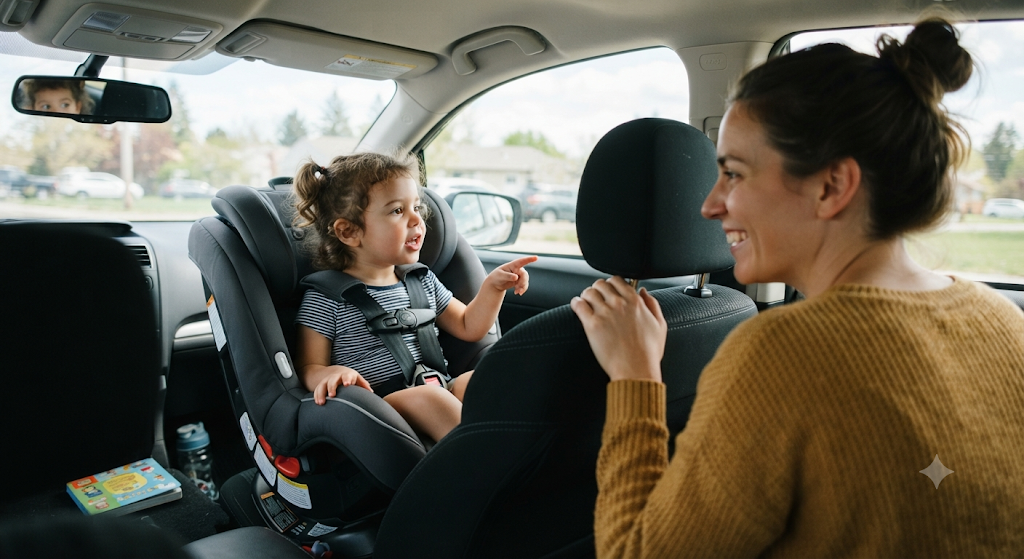
How to Encourage Speech During Everyday Routines
You don’t need a lesson plan to build language everyday moments are full of opportunities.
- Meal times: Narrate what you’re eating and ask the child to request items by name instead of pointing.
- Bath time: Name body parts, bath toys, and actions like “pour,” “splash,” and “squeeze.”
- Car rides: Play “I spy” or describe what you see out the window together.
- Shopping: Ask the child to help find and name items on the list.
- Bedtime stories: Pause to ask what might happen next or how a character feels.
- Outdoor play: Narrate movement words like “climb,” “slide,” and “jump.”
- Household chores: Give simple two-step directions, like “get the towel, then wipe the table.”

Common Mistakes Adults Make When Encouraging Speech
- Asking too many questions in a row, which can feel like an interrogation rather than a conversation.
- Correcting every mistake, which can make a child hesitant to speak at all. Model the correct version instead of pointing out the error.
- Speaking too quickly, which makes it harder for a developing ear to pick out individual words.
- Using screens as a conversation replacement during meals or downtime, reducing back-and-forth talk time.
- Not giving children enough time to respond — a slow, silent pause of 5–10 seconds often works better than jumping in.
Speech Activities for Different Skill Levels
Children who speak very little: Start with Animal Sounds, Sound Imitation, and Bubble Talk. Keep the bar low — imitating a sound or gesture is real progress.
Children with emerging sentences: Try Picture Naming, Puppet Conversations, and Category Sorting to build toward two- and three-word combinations.
Children with clear speech but limited vocabulary: Move to Story Retelling, Show and Tell, and Book Talk to stretch sentence complexity and topic range.
Frequently Asked Questions
How can I improve my 3-year-old’s speech at home?
Talk through daily routines, read together often, and give your child plenty of unhurried time to respond during conversation.
What games improve speech?
Games involving naming, imitation, and turn-taking like Picture Naming, Puppet Conversations, and Rhyming Games are especially effective.
When should I worry about speech delay?
If your child’s speech is largely unintelligible for their age, or they’re not combining words by age 3, it’s worth a screening with a licensed speech-language pathologist.
How long should speech activities last?
Short, frequent sessions of 10–15 minutes work better than long, infrequent ones.
Can reading books improve speech?
Yes shared reading builds vocabulary, listening comprehension, and sentence structure, especially when you pause to ask questions.
Do I need special toys or materials?
No. Everyday household items and picture books are enough for most activities.
Is it normal for preschoolers to mispronounce sounds?
Yes, many sounds develop gradually through age 5 or later; occasional errors are typical at this age.
How can teachers fit speech practice into a busy day?
Build it into transitions, circle time, and snack time rather than treating it as a separate lesson.
What if my child gets frustrated during activities?
Shorten the session, lower the difficulty, and end on a success to keep the experience positive.
Should I correct my child’s grammar mistakes?
Model the correct form naturally in your response rather than pointing out the error directly.
Can bilingual children do these activities too? Yes — bilingual exposure is not a cause of speech delay, and these activities work well in any home language.
How do I know if it’s a speech delay or just shyness? A pattern of limited communication across settings (home, school, with family) is more concerning than quietness with unfamiliar people only.
What’s the difference between speech and language? Speech refers to sound production and clarity; language refers to understanding and using words and sentences to communicate.
Conclusion
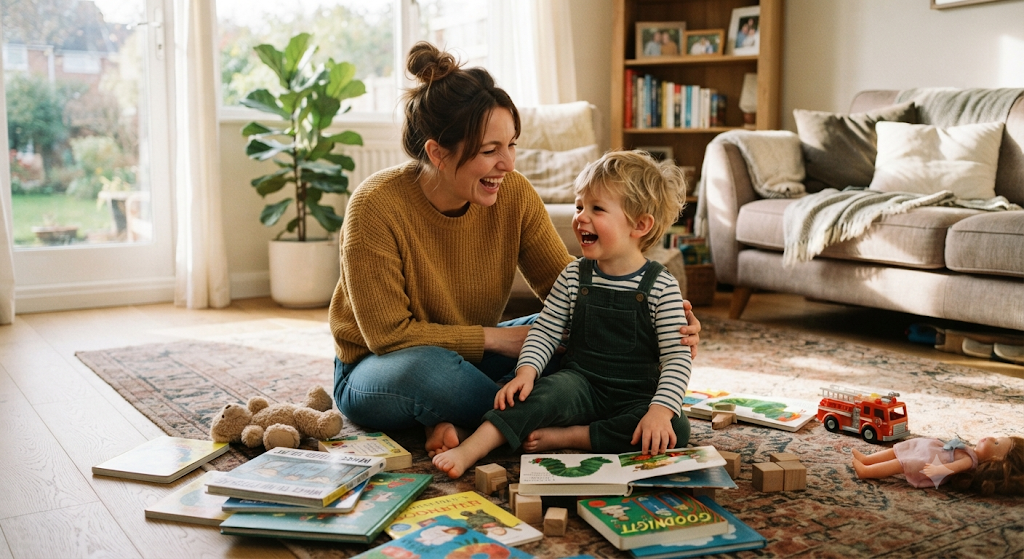
Speech and language grow through everyday play, not perfection. Picture Naming, Story Retelling, Rhyming Games, and the other activities above all give your child low-pressure chances to practice talking, listening, and connecting. Aim for just 10–15 minutes of playful talk each day, tucked into routines you already have — meal times, bath time, the drive to school. Consistency, not intensity, is what moves the needle. If concerns persist despite regular practice, a licensed speech-language pathologist can offer a proper assessment and personalized guidance.
Pick one activity from this list, try it today, and watch how a few minutes of playful talk can open up a conversation.